Ace - AI Tutor
Ask Our Educators
Textbooks
My Library
Flashcards
Scribe - AI Notes
Notes & Exams
Download App
warren ho

warren h.

Divider

Questions asked

BEST MATCH

Some evidence suggests that A. garhi may have been the first hominid to use tools. Group of answer choices True False

View Answer
divider
BEST MATCH

Laboratory experiments are the primary and main method used to develop all scientific knowledge.

View Answer
divider
BEST MATCH

Consider a triangle ABC like the one below. Suppose that $b = 36$, $a = 28$, and $B = 120^\circ$. (The figure is not drawn to scale.) Solve the triangle. Carry your intermediate computations to at least four decimal places, and round your answers to the nearest tenth. If no such triangle exists, enter "No solution." If there is more than one solution, use the button labeled "or". $A = \boxed{ }^\circ$; $C = \boxed{ }^\circ$; $c = \boxed{ }$

View Answer
divider
BEST MATCH

Scenario: Assets and Liabilities of the Banking System Assets Loans Reserves $900,000 100,000 Reference: Ref 14-12 Liabilities Deposits $1,000,000 (Scenario: Assets and Liabilities of the Banking System) Suppose that the reserve ratio is 10% when the Fed buys $100,000 worth of U.S. Treasury bills from the banking system. If the banking system does NOT want to hold any excess reserves, ______ will be added to the money supply. ? $250,000 ? $666,667 ? $1 million ? $111,111

View Answer
divider
BEST MATCH

Question 4 4(a) A lifting device for heavy loads is equipped with two hydraulic cylinders which must advance at the same speed, even if the load is not evenly distributed between them. Design a manually controlled hydraulic circuit to operate both rams. [6] 4(b) A machine tool's manually operated hydraulic circuit is to be equipped with a rapid-traverse feed circuit. Design a circuit to effect this using a 4/2 way hand operated valve in conjunction with a 2/2 way roller operated valve for initiating switchover from rapid traverse to the slower feed rate. The circuit shown should also incorporate pump, reservoir and bypass valve. [8] 4 (c) For the hydraulic circuit shown in Figure 4c indicate what each element is and explain clearly [6] how the circuit works.

View Answer
divider
BEST MATCH

The following is not a part of an assembly language instruction Group of answer choices A. LABEL B. OPCODE C. OPERANDS D. COMMENT E. PC

View Answer
divider
BEST MATCH

Filesystem concepts Determine whether the following statements are true or false. Group of answer choices The name of a file is part of the file's metadata

View Answer
divider
BEST MATCH

Lauren is offered a gamble based on a deck of cards. They will pull one card, and their winnings will be based on the suit: ● If Lauren pulls a diamond, they get $4 ● If Lauren pulls a heart, they get $20 ● If Lauren pulls a spade, they get $0 ● If Lauren pulls a club, they have to pay $10 (they “get” -$20) This is a full deck of 52 cards, so there is a 25% chance of each suit appearing. a) What is the expected value of this game? b) Lauren’s utility for winning (regardless of the amount) is 100 utils, and their utility for losing is -240 utils. Their utility for getting $0 is 0 utils. What is the expected utility for Lauren? c) Lauren is feeling unlucky today, so they feel like the probability of getting a spade or club is 30% each, and the probability of getting a heart or diamond is 20% each. What is the subjective expected utility for Lauren? d) Imagine Lauren is offered this gamble, but is required to buy a ticket in order to play. The ticket costs $1, and Lauren’s utility for $1 is 15 utils. i. Should Lauren buy a ticket to play this game, based on EV theory? ii. Would Lauren be willing to buy a ticket to play this game, based on utility theory? Why or why not?

View Answer
divider
BEST MATCH

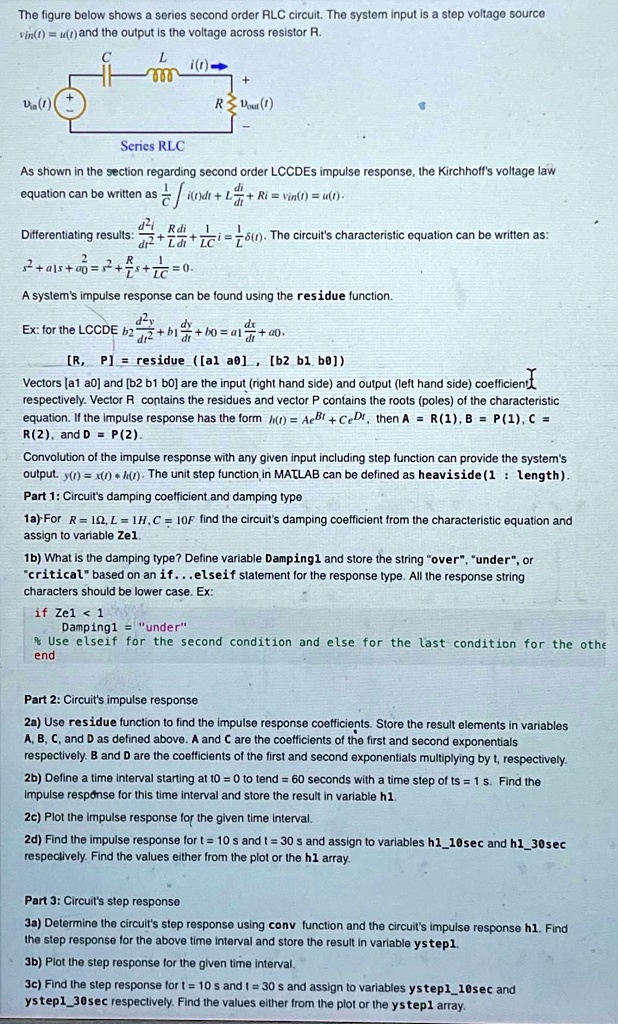
The figure below shows a series second-order RLC circuit. The system input is a step voltage source vin(t) = u(t) and the output is the voltage across resistor R. As shown in the section regarding second-order LCCDEs impulse response, the Kirchhoff's voltage law equation can be written as (1)/(C)∫i(t)dt + L(di)/(dt) + Ri = vin(t) = u(t). Differentiating results: (d^(2)i)/(dt^(2)) + (R)/(L)(di)/(dt) + (1)/(LC)i = (1)/(L)δ(t). The circuit's characteristic equation can be written as: s^(2) + a1s + a_(0)^(2) = s^(2) + (R)/(L)s + (1)/(LC) = 0. A system's impulse response can be found using the residue function. Ex: for the LCCDE b_(2)(d^(2)y)/(dt^(2)) + b_(1)(dy)/(dt) + b0 = a1(dx)/(dt) + a0. [[R, P]] = residue([[a, a0]], [b2, b1, b0]) Vectors a1a0 and b2b1b0 are the input (right-hand side) and output (left-hand side) coefficients, respectively. Vector R contains the residues and vector P contains the roots (poles) of the characteristic equation. If the impulse response has the form h(t) = Ae^(Bt) + Ce^(Dt), then A = R(1), B = P(1), C = R(2), and D = P(2). Convolution of the impulse response with any given input including the step function can provide the system's output. y(t) = x(t)**h(t). The unit step function in MATLAB can be defined as heaviside(1:length). Part 1: Circuit's damping coefficient and damping type 1a) For R = 1Ω, L = 1H, C = 10F, find the circuit's damping coefficient from the characteristic equation and assign to variable Zel. 1b) What is the damping type? Define variable Damping1 and store the string "over", "under", or "critical" based on an if... elseif statement for the response type. All the response string characters should be lowercase. Ex: if Ze1 < 1 Damping1 = "under" % Use elseif for the second condition and else for the last condition for the other end Part 2: Circuit's impulse response 2a) Use the residue function to find the impulse response coefficients. Store the result elements in variables A, B, C, and D as defined above. A and C are the coefficients of the first and second exponentials, respectively. B and D are the coefficients of the first and second exponentials multiplying by t, respectively. 2b) Define a time interval starting at t0 = 0 to tend = 60 seconds with a time step of ts = 1s. Find the impulse response for this time interval and store the result in variable h1. 2c) Plot the impulse response for the given time interval. 2d) Find the impulse response for t = 10s and t = 30s and assign to variables h1_(10)sec and h1_30sec, respectively. Find the values either from the plot or the h1 array. Part 3: Circuit's step response 3a) Determine the circuit's step response using the conv function and the circuit's impulse response h1. Find the step response for the above time interval and store the result in variable ystep1. 3b) Plot the step response for the given time interval. 3c) Find the step response for t = 10s and t = 30s and assign to variables ystep1_10sec and ystep1_30sec, respectively. Find the values either from the plot or the ystep1 array.
View Answer
divider
BEST MATCH

The functions f and g. Find the area of the region enclosed between $f(x) = 0.25x - 0.5$ and $g(x) = -1.5x^2$. Area = help (numbers) (Note: The graph provided represents both functions f and g but is intentionally left unlabeled.)

View Answer
divider