Ace - AI Tutor
Ask Our Educators
Textbooks
My Library
Flashcards
Scribe - AI Notes
Notes & Exams
Download App
traci miller

traci m.

Divider

Questions asked

BEST MATCH

Spontaneous oxidation-reduction reactions have E^(0)<0. â—» True False Spontaneous oxidation-reduction reactions have $E^0 < 0$. True False

View Answer
divider
BEST MATCH

52. "The sum of all the currents flowing towards a point is equal to the sum of all the currents flowing away from the point", is the statement of \( \qquad \) A. Flehmening's Rule B. Kirchhoff's First Rule C. Kirchhoff's Second Rule D. Right Hand Rule

View Answer
divider
BEST MATCH

Question 6 (0.5 points) Which of the following aspects of a culture would be categorized as an informal institution? Economics Laws Politics Ethics

View Answer
divider
BEST MATCH

\( \sigma^{2}=\frac{\varepsilon f(x-\bar{x})^{2}}{\varepsilon f-1} \)

View Answer
divider
BEST MATCH

A particle with a charge of 6.7nC is in a uniform electric field

View Answer
divider
BEST MATCH

From the following list, select all that define the functions of enzymes. (Check all that apply.) A high salt concentration range A narrow pH range A narrow salt concentration range A narrow temperature range A wide temperature range

View Answer
divider
BEST MATCH

A particle comes into existence moving along a straight axis at $t \ge 0$ in such a way that its acceleration at the time $t$ is given by the equation $a(t) = (6 \text{m/s}^2)t - 10 \text{m/s}^2$. If the particle's initial velocity is $4 \text{ m/s}$ and its initial position is $x = 24 \text{ m}$, determine a. the time at which the particle's velocity is $6 \text{ m/s}$ b. the time at which the particle switches directions c. the particle's position at time $t = 6 \text{ s}$ d. the particle's displacement at $t = 6 \text{ s}$ (since its coming into existence) e. the distance the particle traveled in the first $6$ seconds.

View Answer
divider
BEST MATCH

Name: VWCC ID#: 5. The two rods are made of an A-36 steel and are connected as shown below. If the cross sectional area of BC is 1 in$^2$ and the cross sectional area of CD is 2 in$^2$, determine the reactions at (a) B and (b) D, when P = 1.2 kip is applied at point C. ($E_{st}$ = 29 Msi) Hint: All deformation is elastic. Use Statics and Deforms. 18 in 18 in D

View Answer
divider
BEST MATCH

13) Find Z in the circuits below. 2\Omega 1\Omega -j1\Omega Z \rightarrow j\Omega 2\Omega 2\Omega (a) 2\Omega j3\Omega 4\Omega j2\Omega Z \rightarrow 3\Omega 5\Omega -j3\Omega 4\Omega (b)

View Answer
divider
BEST MATCH

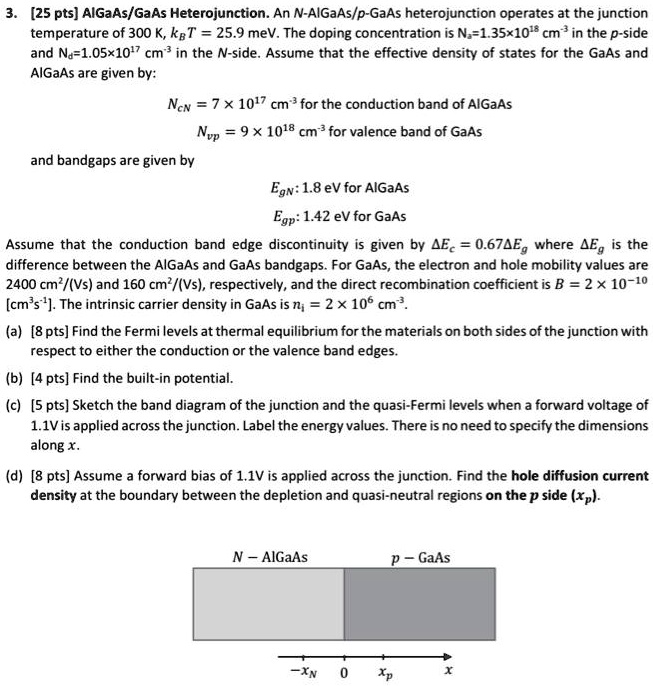
AIGaAs/GaAs Heterojunction. An N-AIGaAs/p-GaAs heterojunction operates at the junction temperature of 300 K, kT = 25.9 meV. The doping concentration is N = 1.35x10^18 cm^(-3) on the p-side and N = 1.05x10^18 cm^(-3) on the N-side. Assume that the effective density of states for the GaAs and AIGaAs are given by Nc = 7.10^17 cm^(-3) for the conduction band of AIGaAs and Nv = 9.10^17 cm^(-3) for the valence band of GaAs. The bandgaps are given by Eg = 1.8 eV for AIGaAs and Egp = 1.42 eV for GaAs. Assume that the conduction band edge discontinuity is given by E = 0.67Eg where Eg is the difference between the AlGaAs and GaAs bandgaps. For GaAs, the electron and hole mobility values are 2400 cm^2/(V.s) and 160 cm^2/(V.s), respectively, and the direct recombination coefficient is B = 2.10^(-10) [cm^3/s]. The intrinsic carrier density in GaAs is n = 2.10^6 cm^(-3). (a) Find the Fermi levels at thermal equilibrium for the materials on both sides of the junction with respect to either the conduction or the valence band edges. (b) Find the built-in potential. (c) Sketch the band diagram of the junction and the quasi-Fermi levels when a forward voltage of 1.1 V is applied across the junction. Label the energy values. There is no need to specify the dimensions along x. (d) Assume a forward bias of 1.1 V is applied across the junction. Find the hole diffusion current density at the boundary between the depletion and quasi-neutral regions on the p side (x). N-AIGaAs p-GaAs -XN 0 Xp x
View Answer
divider