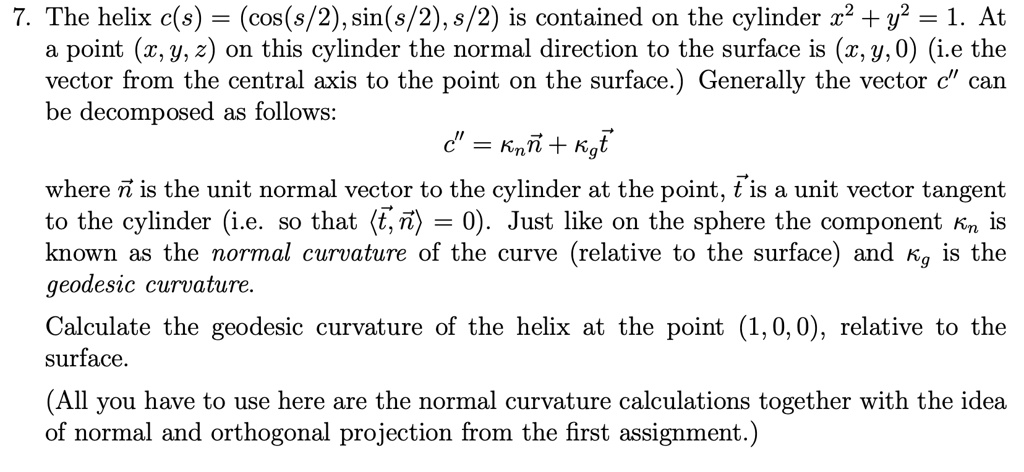
7. The helix c(s) = (cos(s/2), sin(s/2), s/2) is contained on the cylinder $x^2 + y^2 = 1$. At
a point (x, y, z) on this cylinder the normal direction to the surface is (x, y, 0) (i.e the
vector from the central axis to the point on the surface.) Generally the vector c'' can
be decomposed as follows:
c'' = \kappa_n \vec{n} + \kappa_g \vec{t}
where $\vec{n}$ is the unit normal vector to the cylinder at the point, $\vec{t}$ is a unit vector tangent
to the cylinder (i.e. so that $(\vec{t}, \vec{n}) = 0$). Just like on the sphere the component $\kappa_n$ is
known as the normal curvature of the curve (relative to the surface) and $\kappa_g$ is the
geodesic curvature.
Calculate the geodesic curvature of the helix at the point (1,0,0), relative to the
surface.
(All you have to use here are the normal curvature calculations together with the idea
of normal and orthogonal projection from the first assignment.)