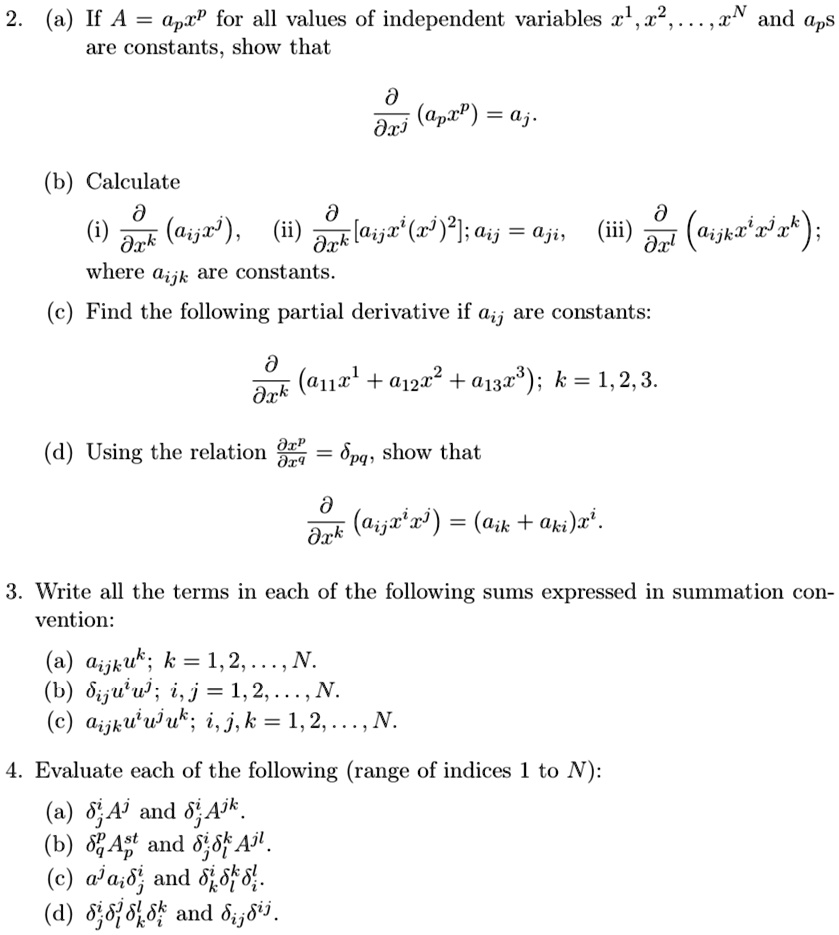
2. (a) If $A = a_p x^p$ for all values of independent variables $x^1, x^2, \dots, x^N$ and $a_{ps}$ are constants, show that
$\frac{\partial}{\partial x^j} (a_p x^p) = a_j$.
(b) Calculate
(i) $\frac{\partial}{\partial x^k} (a_{ij} x^j)$, (ii) $\frac{\partial}{\partial x^k} [a_{ij} x^i (x^j)^2]$; $a_{ij} = a_{ji}$, (iii) $\frac{\partial}{\partial x^l} (a_{ijk} x^i x^j x^k)$;
where $a_{ijk}$ are constants.
(c) Find the following partial derivative if $a_{ij}$ are constants:
$\frac{\partial}{\partial x^k} (a_{11} x^1 + a_{12} x^2 + a_{13} x^3)$; $k = 1, 2, 3$.
(d) Using the relation $\frac{\partial x^p}{\partial x^q} = \delta_{pq}$, show that
$\frac{\partial}{\partial x^k} (a_{ij} x^i x^j) = (a_{ik} + a_{ki}) x^i$.
3. Write all the terms in each of the following sums expressed in summation convention:
(a) $a_{ijk} u^k$; $k = 1, 2, \dots, N$.
(b) $\delta_{ij} u^i u^j$; $i, j = 1, 2, \dots, N$.
(c) $a_{ijk} u^i u^j u^k$; $i, j, k = 1, 2, \dots, N$.
4. Evaluate each of the following (range of indices 1 to N):
(a) $\delta_i^j A^i$ and $\delta_i^j A_{jk}$.
(b) $\delta_q^p A_{st}$ and $\delta_i^k \delta_k^l A_{il}$.
(c) $a^i_j \delta_i^j$ and $\delta_i^k \delta_k^l \delta_l^i$.
(d) $\delta_i^j \delta_j^k \delta_k^i$ and $\delta_{ij} \delta^{ij}$.