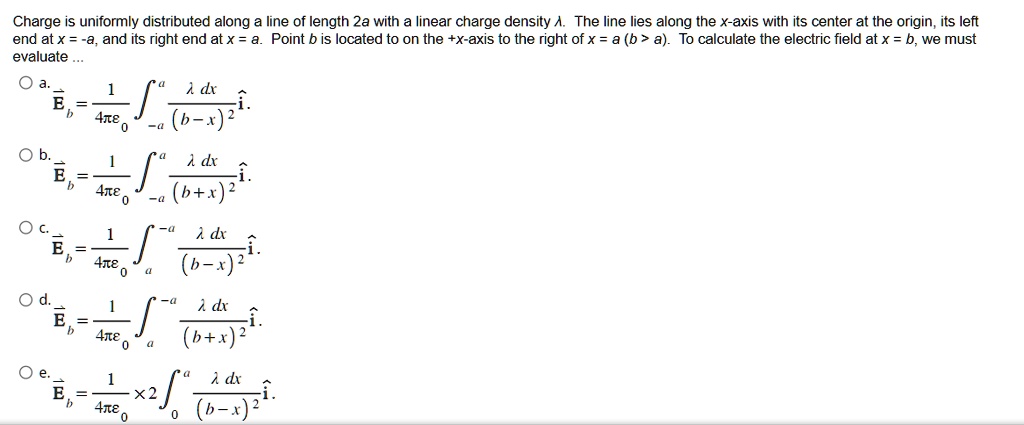
Charge is uniformly distributed along a line of length 2a with a linear charge density \lambda. The line lies along the x-axis with its center at the origin, its left end at x = -a, and its right end at x = a. Point b is located to on the +x-axis to the right of x = a (b > a). To calculate the electric field at x = b, we must evaluate
a. $\vec{E}_b = \frac{1}{4\pi\epsilon_0} \int_{-a}^{a} \frac{\lambda \, dx}{(b - x)^2} \hat{i}$
b. $\vec{E}_b = \frac{1}{4\pi\epsilon_0} \int_{-a}^{a} \frac{\lambda \, dx}{(b + x)^2} \hat{i}$
c. $\vec{E}_b = \frac{1}{4\pi\epsilon_0} \int_{0}^{a} \frac{\lambda \, dx}{(b - x)^2} \hat{i}$
d. $\vec{E}_b = \frac{1}{4\pi\epsilon_0} \int_{0}^{-a} \frac{\lambda \, dx}{(b + x)^2} \hat{i}$
e. $\vec{E}_b = \frac{1}{4\pi\epsilon_0} \times 2 \int_{0}^{a} \frac{\lambda \, dx}{(b - x)^2} \hat{i}$