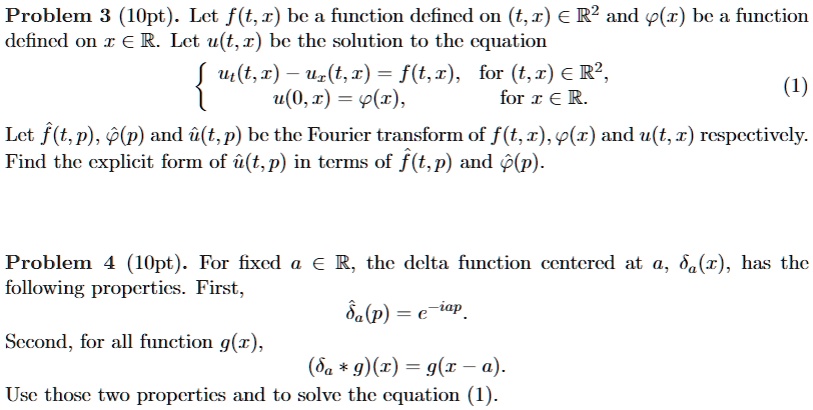
Problem 3 (10pt). Let $f(t, x)$ be a function defined on $(t, x) \in \mathbb{R}^2$ and $\varphi(x)$ be a function defined on $x \in \mathbb{R}$. Let $u(t, x)$ be the solution to the equation \begin{equation*} \begin{cases} u_t(t, x) - u_x(t, x) = f(t, x), & \text{for } (t, x) \in \mathbb{R}^2, \\ u(0, x) = \varphi(x), & \text{for } x \in \mathbb{R}. \end{cases} (1) \end{equation*} Let $\hat{f}(t, p)$, $\hat{\varphi}(p)$ and $\hat{u}(t, p)$ be the Fourier transform of $f(t, x)$, $\varphi(x)$ and $u(t, x)$ respectively. Find the explicit form of $\hat{u}(t, p)$ in terms of $\hat{f}(t, p)$ and $\hat{\varphi}(p)$. Problem 4 (10pt). For fixed $a \in \mathbb{R}$, the delta function centered at $a$, $\delta_a(x)$, has the following properties. First, $\hat{\delta}_a(p) = e^{-iap}$. Second, for all function $g(x)$, $(\delta_a * g)(x) = g(x - a)$. Use those two properties and to solve the equation (1).