Complete Aircraft:
Gross weight (includes everything) = 13,000 lb, Wing Area = 320 ft², mean chord length of wing
= 6 ft. The moment coefficient about the aerodynamic center is $C_{M,0} = -0.03$ (positive nose up).
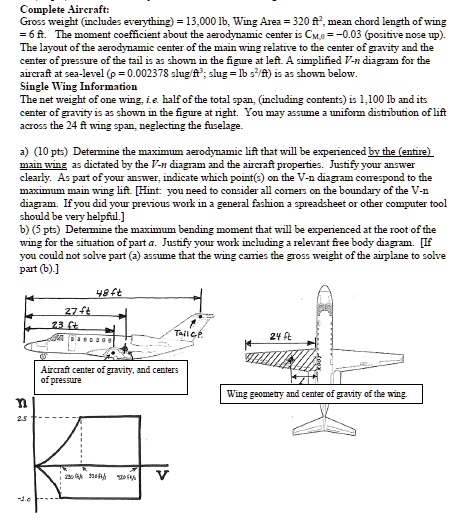
The layout of the aerodynamic center of the main wing relative to the center of gravity and the
center of pressure of the tail is as shown in the figure at left. A simplified V-n diagram for the
aircraft at sea-level ($\rho = 0.002378$ slug/ft³; slug = lb s²/ft) is as shown below.
Single Wing Information
The net weight of one wing, i.e. half of the total span, (including contents) is 1,100 lb and its
center of gravity is as shown in the figure at right. You may assume a uniform distribution of lift
across the 24 ft wing span, neglecting the fuselage.
a) (10 pts) Determine the maximum aerodynamic lift that will be experienced by the (entire)
main wing as dictated by the V-n diagram and the aircraft properties. Justify your answer
clearly. As part of your answer, indicate which point(s) on the V-n diagram correspond to the
maximum main wing lift. [Hint: you need to consider all corners on the boundary of the V-n
diagram. If you did your previous work in a general fashion a spreadsheet or other computer tool
should be very helpful.]
b) (5 pts) Determine the maximum bending moment that will be experienced at the root of the
wing for the situation of part a. Justify your work including a relevant free body diagram. [If
you could not solve part (a) assume that the wing carries the gross weight of the airplane to solve
part (b).]
48 ft
27 ft
23 ft
n
2.5
Aircraft center of gravity, and centers
of pressure
-1.0
V
Tail c.p.
24 ft
Wing geometry and center of gravity of the wing.