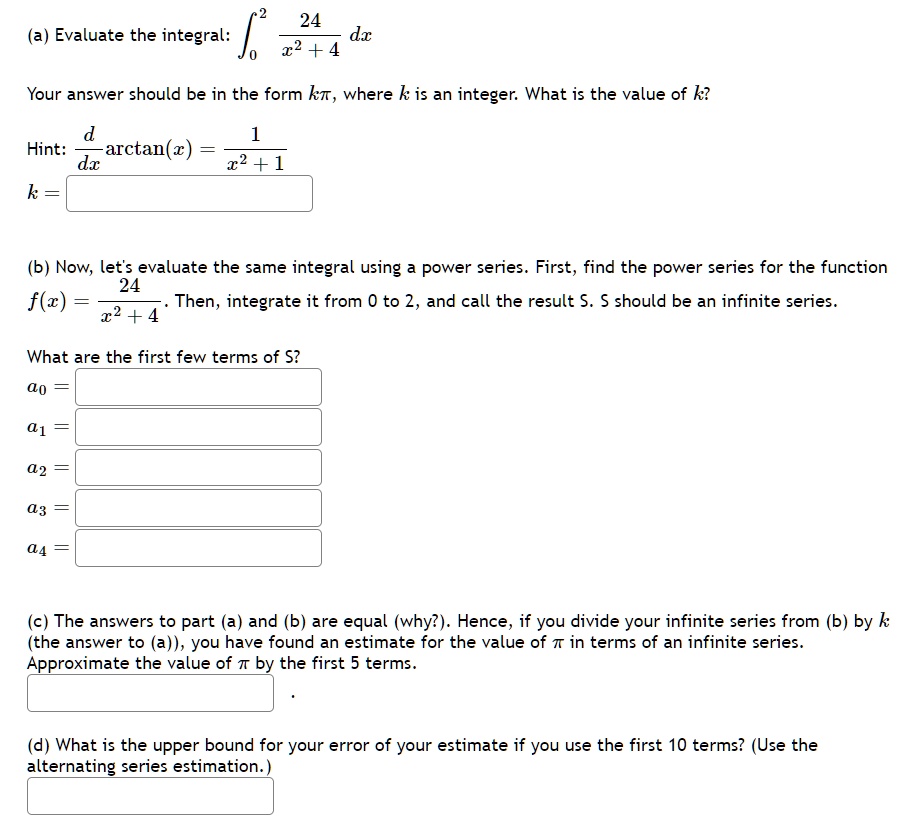
(a) Evaluate the integral: int_0^2 (24)/(x^(2)+4)dx
Your answer should be in the form kpi , where k is an integer. What is the value of k ?
Hint: (d)/(dx)arctan(x)=(1)/(x^(2)+1)
k=
(b) Now, let's evaluate the same integral using a power series. First, find the power series for the function
f(x)=(24)/(x^(2)+4). Then, integrate it from 0 to 2 , and call the result S. S should be an infinite series.
What are the first few terms of S ?
a_(0)=
a_(1)=
a_(2)=
a_(3)=
a_(4)=
(c) The answers to part (a) and (b) are equal (why?). Hence, if you divide your infinite series from (b) by k
(the answer to (a)), you have found an estimate for the value of pi in terms of an infinite series.
Approximate the value of pi by the first 5 terms.
(d) What is the upper bound for your error of your estimate if you use the first 10 terms? (Use the
alternating series estimation.)
24
(a) Evaluate the integral:
da
Your answer should be in the form krt, where k is an integer. What is the value of k?
d Hint: arctan(c dx
1
x2+1
k
(b) Now, let's evaluate the same integral using a power series. First, find the power series for the function 24 f(x)= Then, integrate it from 0 to 2, and call the result S. S should be an infinite series. x2 +4
What are the first few terms of S?
=0p
a1
a2=
a3=
a4
c) The answers to part(a) and(b are equal(why?.Hence, if you divide your infinite series from (b by k the answer to (a), you have found an estimate for the value of r in terms of an infinite series. Approximate the value of T by the first 5 terms.
(d) What is the upper bound for your error of your estimate if you use the first 10 terms? (Use the alternating series estimation.