Ace - AI Tutor
Ask Our Educators
Textbooks
My Library
Flashcards
Scribe - AI Notes
Notes & Exams
Download App
ronald davis

ronald d.

Divider

Questions asked

BEST MATCH

16-3 What is the open-loop voltage gain of an LF157A when the input frequency is 1 kHz? 10 kHz? 100 kHz? (Assume a first-order response, that is, 20 dB per decade rolloff.)

View Answer
divider
BEST MATCH

A sample of argon gas at 312 K and 0.444 atm occupies a volume of 4.40 L. If the pressure of the gas is increased, while at the same time it is heated to a higher temperature, the final gas volume

View Answer
divider
BEST MATCH

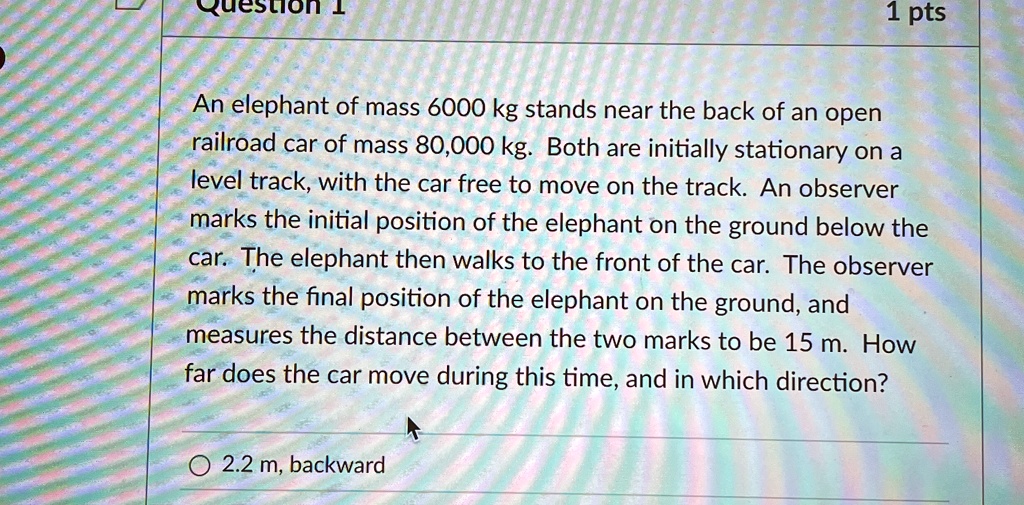
1 pts An elephant of mass 6000 kg stands near the back of an open railroad car of mass 80,000 kg. Both are initially stationary on a level track, with the car free to move on the track. An observer marks the initial position of the elephant on the ground below the car. The elephant then walks to the front of the car. The observer marks the final position of the elephant on the ground, and measures the distance between the two marks to be 15 m. How far does the car move during this time, and in which direction? 2.2 m, backward
View Answer
divider
BEST MATCH

Match the following key terms with their definition: 1 The first set of measurements you take to which subsequent measurements can be compared. Radiation is the transfer of heat from the surface of one object to the surface of another without direct contact between the two. Temperature of 34 to 36 degrees Celsius Temperature above 38 degrees Celsius, Fever Transfer of heat from one object to another through direct contact Fever causing Transfer of heat energy when a liquid is changed to a gas. Sweating Fever relieving Temperature of structures deep within the body Transfer of heat away from the body by air movement. Difference between the amount of heat produced by body processes and the amount lost to the external environment Temperature 38 to 44 degrees Celsius Normal body temperature of 36-38 degrees Celsius Without fever 1. Baseline Vitals 2. Febrile/Pyrexia 3. Pyrogen 4. Antipyretic 5. Afebrile 6. Hyperthermia 7. Hypothermia 8. Normothermia 9. Diaphoresis 10. Radiation 11. Conduction 12. Convection 13. Evaporation 14. Body Temperature 15. Core Temperature 6 8 5

View Answer
divider
BEST MATCH

Our macronutrients go through 3 stages of catabolism to provide our bodies with ________. ATP vitamins and minerals amino acids oxygen

View Answer
divider
BEST MATCH

Chemical engineering.. What is the main use of a boiler in industrial processes?

View Answer
divider
BEST MATCH

Precipitation that falls on land returns to the atmosphere through evaporation off of surfaces (leaves, soil, etc.) and from all living plants, particularly trees, as they pull water from the soil and out through stomata in their leaves. Group of answer choices photosynthesis transpiration respiration

View Answer
divider
BEST MATCH

Participation Activity #12 This is similar to Try It #5 in the OpenStax text. Solve $7^x = 8x + 1$. Enter the exact answer. Hint: Take the natural logarithm (ln) of both sides.

View Answer
divider
BEST MATCH

Solve the system by either the addition method or the substitution method.\\ $\begin{cases} 3x + 5y = 10\\ 5x - 6y = -67.9 \end{cases}$\\Select the correct choice below and, if necessary, fill in the answer box within your choice.\ A. The solution is $\boxed{}$ (Simplify your answer. Type an ordered pair.)\ B. There are infinitely many solutions; $\{(x,y) | 3x + 5y = 10\}$ or $\{(x,y)|5x - 6y = -67.9\}$.\nC. There is no solution; $\emptyset$ or $\varnothing$.

View Answer
divider
BEST MATCH

Q4. Let $f$ is bounded inc. function, $g_n : [0,1] \rightarrow \mathbb{R}$, $g_n(x) = f(nx)$. show that : a) $g_n$ is inc. function b) $g_n$ is uniformly bounded c) $\int_0^1 \lim_{n \rightarrow \infty} g_n(x) = \lim_{n \rightarrow \infty} \int_0^1 g_n(x)$

View Answer
divider