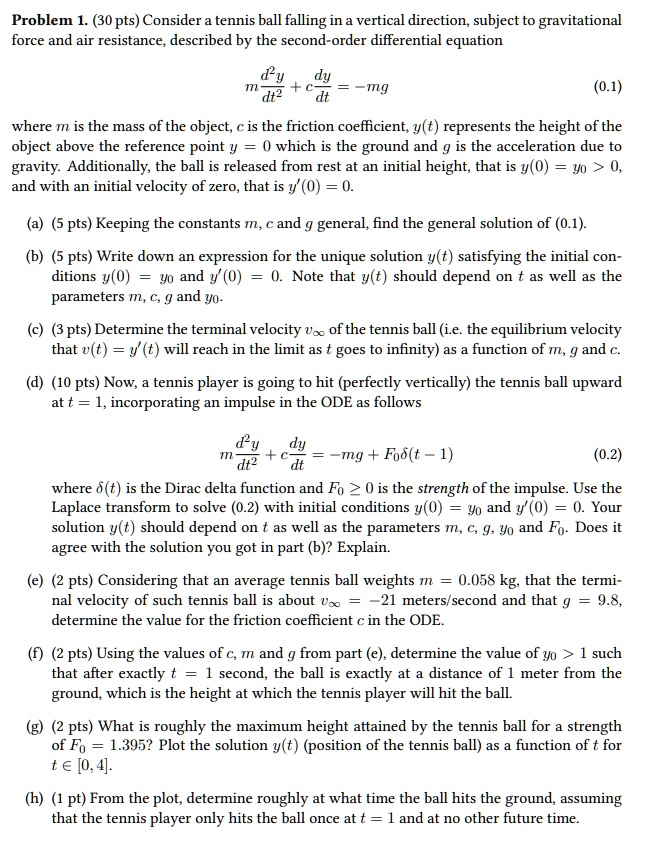
Problem 1. (30 pts) Consider a tennis ball falling in a vertical direction, subject to gravitational force and air resistance, described by the second-order differential equation
d2y dy bu- P P
(0.1)
where m is the mass of the object, c is the friction coefficient, y(t) represents the height of the object above the reference point y = 0 which is the ground and g is the acceleration due to gravity. Additionally, the ball is released from rest at an initial height, that is y(0) = yo > 0, and with an initial velocity of zero, that is y(0) 0
(a) (5 pts) Keeping the constants m, c and g general, find the general solution of (0.1).
(b) (5 pts) Write down an expression for the unique solution y(t) satisfying the initial con- ditions y0) = yo and y0) = 0. Note that y(t) should depend on t as well as the parameters m, c, g and yo.
(c) (3 pts) Determine the terminal velocity vo of the tennis ball (i.e. the equilibrium velocity that (t) = y(t) will reach in the limit as t goes to infinity) as a function of m, g and c.
(d) (10 pts) Now, a tennis player is going to hit (perfectly vertically) the tennis ball upward at t = 1, incorporating an impulse in the ODE as follows
dy -mg+Fo(t-1) P
(0.2)
where (t) is the Dirac delta function and Fo > 0 is the strength of the impulse. Use the Laplace transform to solve (0.2) with initial conditions y(0) = Yo and y(0) = 0. Your solution y(t) should depend on t as well as the parameters m, c, g, Yo and Fo. Does it agree with the solution you got in part (b)? Explain.
e2 pts) Considering that an average tennis ball weights m = 0.058 kg,that the termi- nal velocity of such tennis ball is about vo = -21 meters/second and that g = 9.8, determine the value for the friction coefficient c in the ODE.
f) (2 pts) Using the values of c, m and g from part (e), determine the value of yo > 1 such that after exactly t = 1 second, the ball is exactly at a distance of 1 meter from the
ground, which is the height at which the tennis player will hit the ball.
(g) (2 pts) What is roughly the maximum height attained by the tennis ball for a strength of Fo = 1.395? Plot the solution y(t) (position of the tennis ball) as a function of t for t [0,4].
(h) (1 pt) From the plot, determine roughly at what time the ball hits the ground, assuming that the tennis player only hits the ball once at t = 1 and at no other future time.