Problem Context
While on a vacation to Kenya, you visit the port city of Mombassa on the Indian Ocean. On the coast,
you find an old Portuguese fort probably built in the 16th century. Large stone walls rise vertically
from the shore to protect the fort from cannon fire from pirate ships. You wonder how close a pirate
ship would have to sail to the fort to be in range of the fort's cannon. Of course you realize that the
range depends on the velocity that the cannonball leaves the cannon, as well as the height of the cliff.
1 Setting up the problem
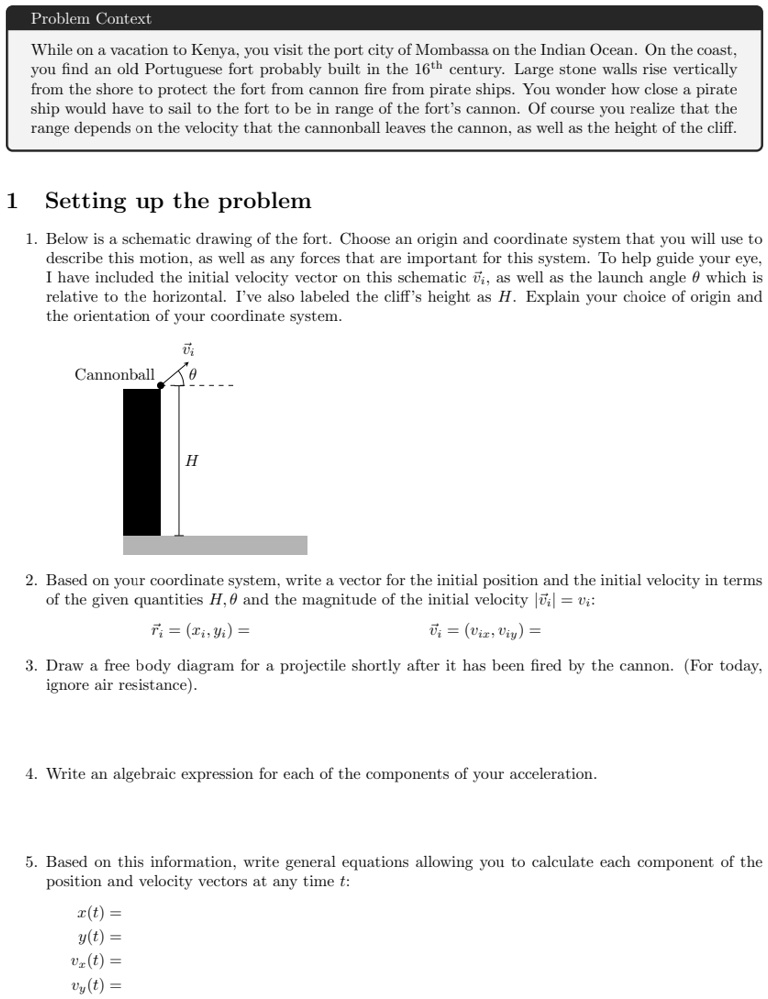
1. Below is a schematic drawing of the fort. Choose an origin and coordinate system that you will use to
describe this motion, as well as any forces that are important for this system. To help guide your eye,
I have included the initial velocity vector on this schematic $\vec{v_i}$, as well as the launch angle $\theta$ which is
relative to the horizontal. I've also labeled the cliff's height as $H$. Explain your choice of origin and
the orientation of your coordinate system.
$\vec{v_i}$
Cannonball
$H$
2. Based on your coordinate system, write a vector for the initial position and the initial velocity in terms
of the given quantities $H$, $\theta$ and the magnitude of the initial velocity $|\vec{v_i}| = v_i$:
$\vec{r_i} = (x_i, y_i) = $
$\vec{v_i} = (v_{ix}, v_{iy}) = $
3. Draw a free body diagram for a projectile shortly after it has been fired by the cannon. (For today,
ignore air resistance).
4. Write an algebraic expression for each of the components of your acceleration.
5. Based on this information, write general equations allowing you to calculate each component of the
position and velocity vectors at any time $t$:
$x(t) = $
$y(t) = $
$v_x(t) = $
$v_y(t) = $