The Centers for Disease Control and Prevention (CDC) estimates that cigarette smoking causes more than 480,000 deaths each
year in the United States. Cigarette smoking also carries a significant financial burden, with an estimated $170 billion of direct
medical expenses and another $156 billion lost from lower worker productivity annually.
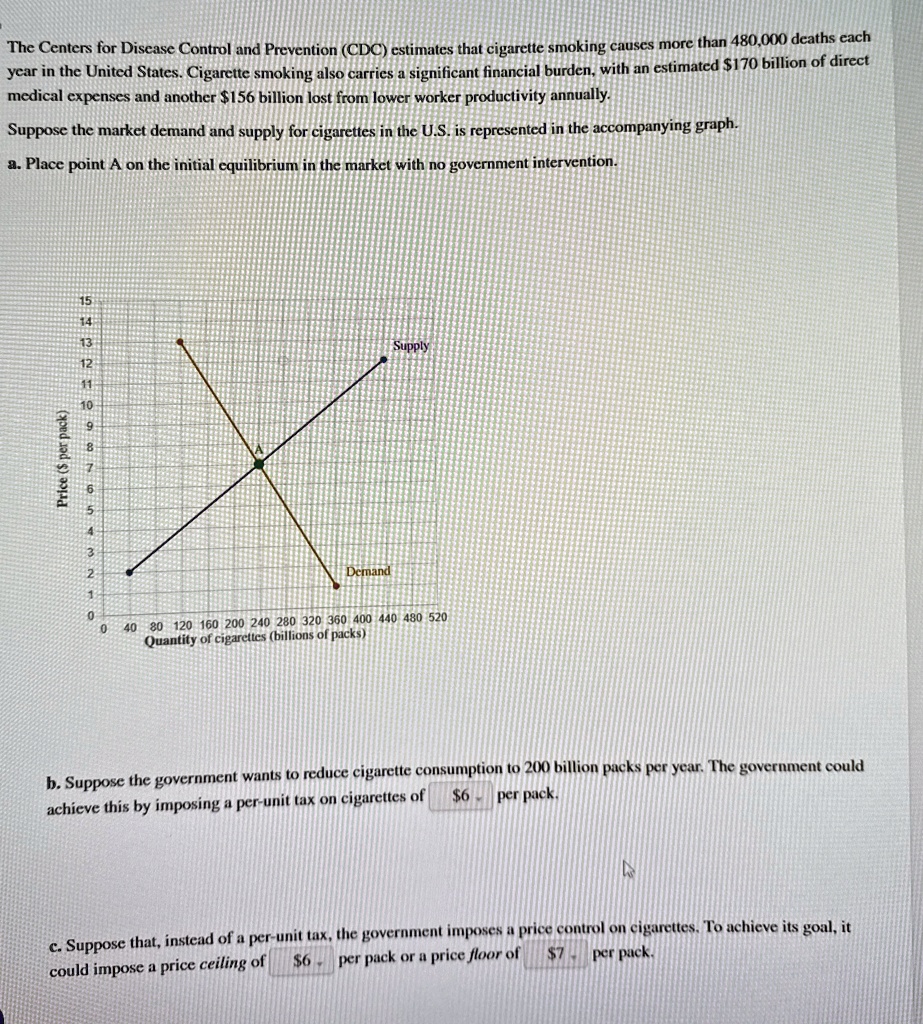
Suppose the market demand and supply for cigarettes in the U.S. is represented in the accompanying graph.
a. Place point A on the initial equilibrium in the market with no government intervention.
Price ($ per pack)
15
14
13
12
11
10
9
8
7
6
5
4
3
2
1
0
Supply
A
Demand
0 40 80 120 160 200 240 280 320 360 400 440 480 520
Quantity of cigarettes (billions of packs)
b. Suppose the government wants to reduce cigarette consumption to 200 billion packs per year. The government could
achieve this by imposing a per-unit tax on cigarettes of $6 per pack.
c. Suppose that, instead of a per-unit tax, the government imposes a price control on cigarettes. To achieve its goal, it
could impose a price ceiling of $6 per pack or a price floor of $7 per pack.