Units of Labour
80
58
40
25
15
10
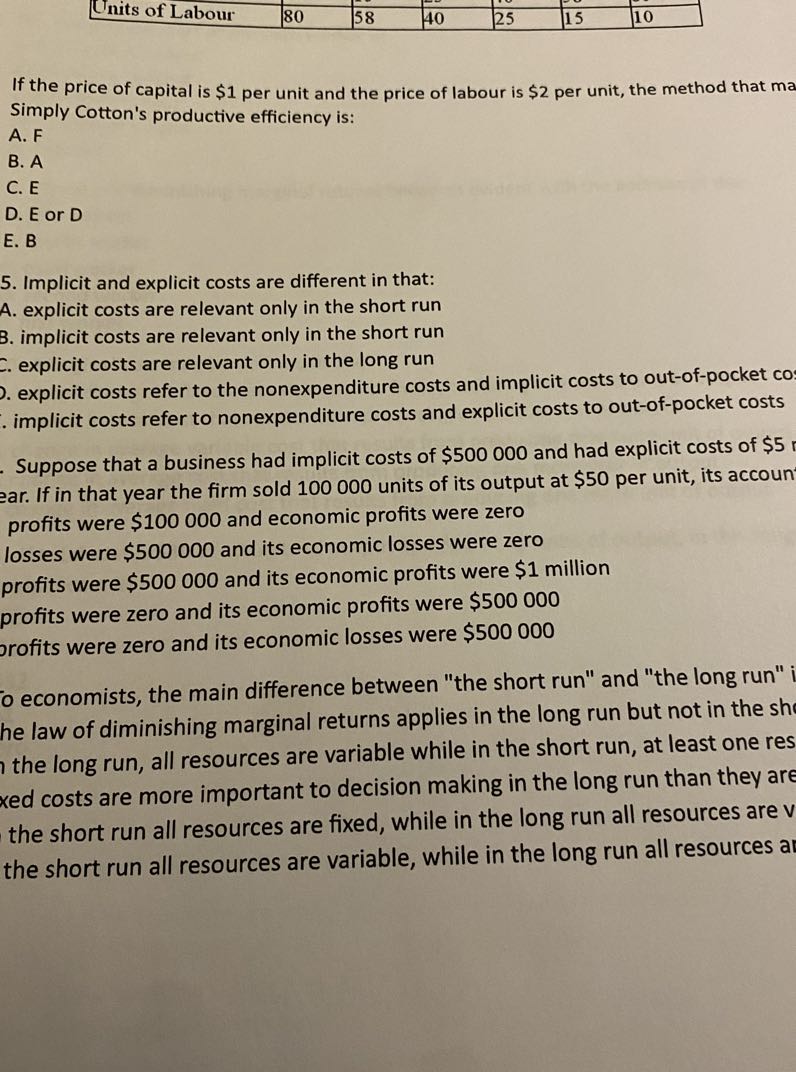
If the price of capital is \( \$ 1 \) per unit and the price of labour is \( \$ 2 \) per unit, the method that ma Simply Cotton's productive efficiency is:
A. F
B. A
C. E
D. E or D
E. B
5. Implicit and explicit costs are different in that:
A. explicit costs are relevant only in the short run
B. implicit costs are relevant only in the short run
-. explicit costs are relevant only in the long run
explicit costs refer to the nonexpenditure costs and implicit costs to out-of-pocket co implicit costs refer to nonexpenditure costs and explicit costs to out-of-pocket costs
Suppose that a business had implicit costs of \( \$ 500000 \) and had explicit costs of \( \$ 5 \) ear. If in that year the firm sold 100000 units of its output at \( \$ 50 \) per unit, its accoun profits were \( \$ 100000 \) and economic profits were zero
losses were \( \$ 500000 \) and its economic losses were zero
profits were \( \$ 500000 \) and its economic profits were \$1 million
profits were zero and its economic profits were \( \$ 500000 \)
orofits were zero and its economic losses were \$500 000
o economists, the main difference between "the short run" and "the long run" \( i \) he law of diminishing marginal returns applies in the long run but not in the sh the long run, all resources are variable while in the short run, at least one res xed costs are more important to decision making in the long run than they are the short run all resources are fixed, while in the long run all resources are \( v \) the short run all resources are variable, while in the long run all resources ar