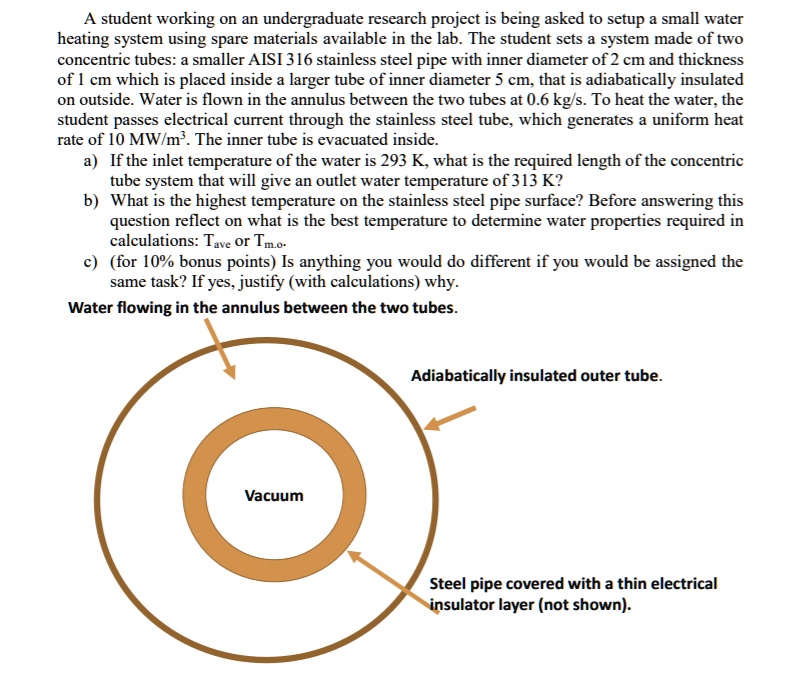
A student working on an undergraduate research project is being asked to setup a small water heating system using spare materials available in the lab. The student sets a system made of two concentric tubes: a smaller AISI 316 stainless steel pipe with inner diameter of 2 cm and thickness of 1 cm which is placed inside a larger tube of inner diameter 5 cm, that is adiabatically insulated on outside. Water is flown in the annulus between the two tubes at 0.6 kg/s. To heat the water, the student passes electrical current through the stainless steel tube, which generates a uniform heat rate of 10 MW/m³. The inner tube is evacuated inside.
a) If the inlet temperature of the water is 293 K, what is the required length of the concentric tube system that will give an outlet water temperature of 313 K?
b) What is the highest temperature on the stainless steel pipe surface? Before answering this question reflect on what is the best temperature to determine water properties required in calculations: $T_{ave}$ or $T_{m,o}$.
c) (for 10% bonus points) Is anything you would do different if you would be assigned the same task? If yes, justify (with calculations) why.
Water flowing in the annulus between the two tubes.
Vacuum
Adiabatically insulated outer tube.
Steel pipe covered with a thin electrical insulator layer (not shown).