Let
$$
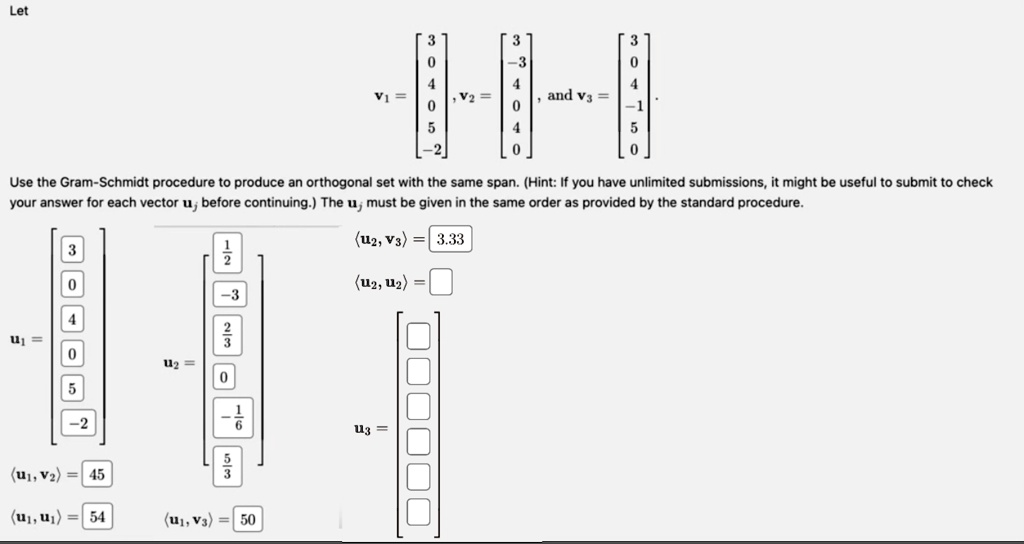
\mathbf{v}_1 = \begin{bmatrix} 3 \\ 0 \\ 4 \\ 0 \\ 5 \\ -2 \end{bmatrix}, \mathbf{v}_2 = \begin{bmatrix} 3 \\ -3 \\ 4 \\ 0 \\ 4 \\ 0 \end{bmatrix}, \text{and} \mathbf{v}_3 = \begin{bmatrix} 3 \\ 0 \\ 4 \\ -1 \\ 5 \\ 0 \end{bmatrix}.
$$
Use the Gram-Schmidt procedure to produce an orthogonal set with the same span. (Hint: If you have unlimited submissions, it might be useful to submit to check your answer for each vector $\mathbf{u}_i$ before continuing.) The $\mathbf{u}_i$ must be given in the same order as provided by the standard procedure.
$$
\mathbf{u}_1 = \begin{bmatrix} 3 \\ 0 \\ 4 \\ 0 \\ 5 \\ -2 \end{bmatrix}, \mathbf{u}_2 = \begin{bmatrix} 1/2 \\ -3 \\ 2/3 \\ 0 \\ -1/6 \\ 5/3 \end{bmatrix}
$$
$$
\langle \mathbf{u}_2, \mathbf{v}_3 \rangle = 3.33
$$
$$
\langle \mathbf{u}_2, \mathbf{u}_2 \rangle =
$$
$$
\mathbf{u}_3 = \begin{bmatrix} \\ \\ \\ \\ \\ \end{bmatrix}
$$
$$
\langle \mathbf{u}_1, \mathbf{v}_2 \rangle = 45
$$
$$
\langle \mathbf{u}_1, \mathbf{u}_1 \rangle = 54
$$
$$
\langle \mathbf{u}_1, \mathbf{v}_3 \rangle = 50
$$