1. Valuing real options
Aa Aa
Real options give the holder the right, but not the obligation, to undertake business decisions-typically those that
involve capital investments.
Real options exist when which of the following occurs?
When a project produces foreign-denominated cash flows
When you can repeat a project multiple times
When you can sell a predetermined number of shares of stock in the future
When managerial actions can alter a project's cash flow stream and, hence, its value
True or False: The presence of managerial, or real, options decreases the value of an investment project.
False
True
Which of the following statements is most accurate about real options?
Real options restrict managers to waiting before deciding on making an investment in a project.
Real options always give managers the flexibility to decide to either invest in a project or wait to make a more
calculated decision at a later date.
Real options do not give managers the flexibility to decide to either invest in a project or wait to make a more
calculated decision at a later date.
Real options can give managers the flexibility to decide to either invest in a project or wait to make a more
calculated decision at a later date.
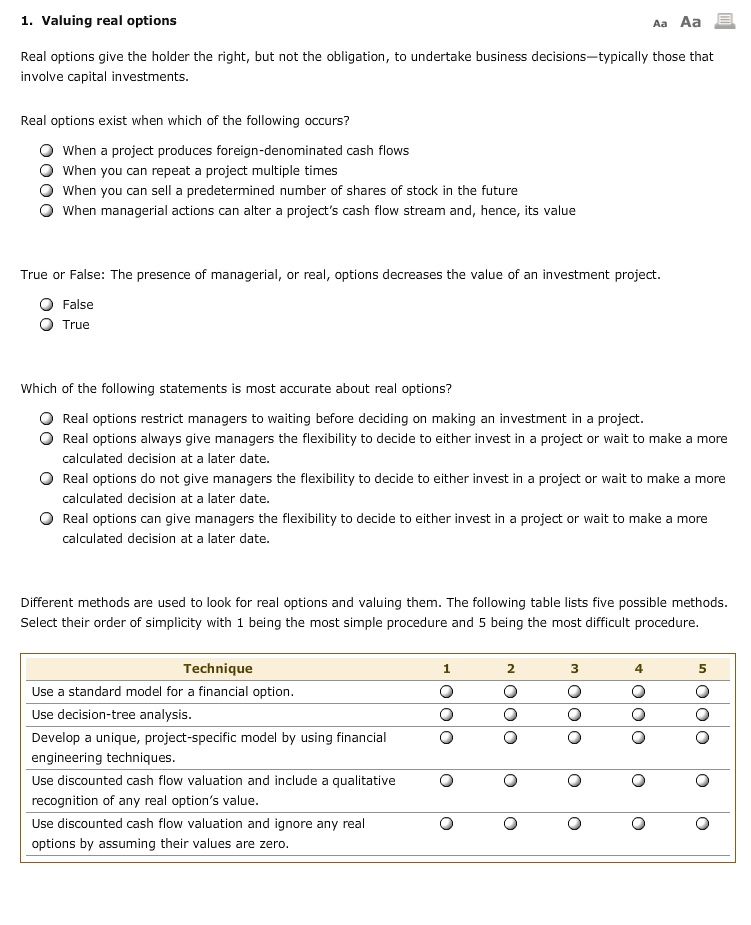
Different methods are used to look for real options and valuing them. The following table lists five possible methods.
Select their order of simplicity with 1 being the most simple procedure and 5 being the most difficult procedure.
Technique
Use a standard model for a financial option.
Use decision-tree analysis.
Develop a unique, project-specific model by using financial
engineering techniques.
Use discounted cash flow valuation and include a qualitative
recognition of any real option's value.
Use discounted cash flow valuation and ignore any real
options by assuming their values are zero.
1
2
3
4
5