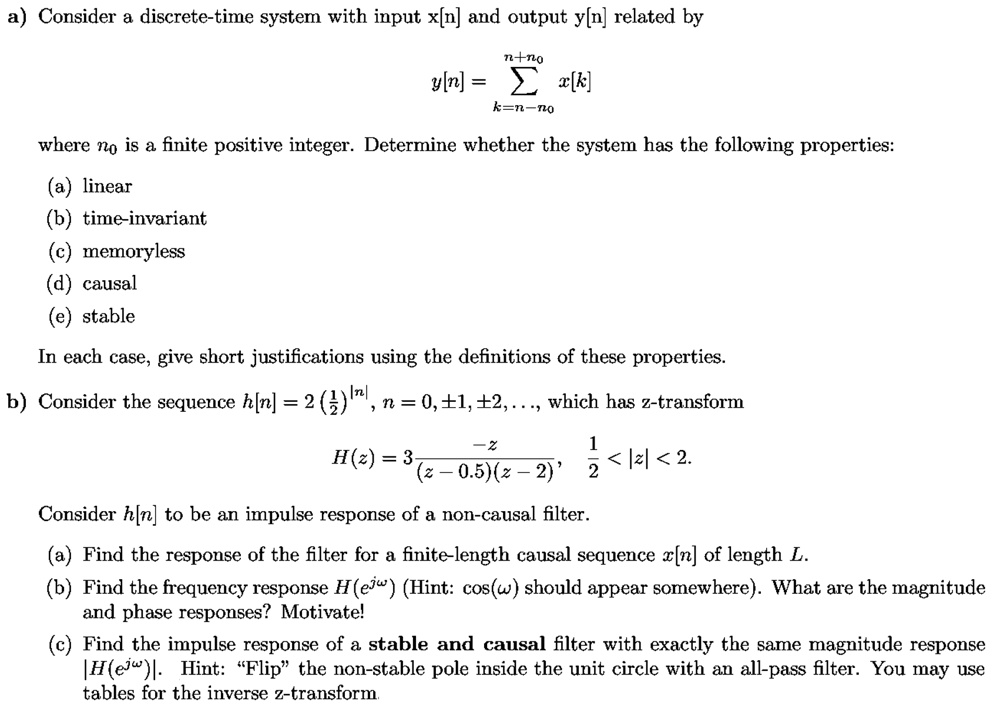
a) Consider a discrete-time system with input x[n] and output y[n] related by
\begin{equation}
y[n] = \sum_{k=n-n_0}^{n+n_0} x[k]
\end{equation}
where $n_0$ is a finite positive integer. Determine whether the system has the following properties:
(a) linear
(b) time-invariant
(c) memoryless
(d) causal
(e) stable
In each case, give short justifications using the definitions of these properties.
b) Consider the sequence $h[n] = 2 \left(\frac{1}{2}\right)^{|n|}$, $n = 0, \pm 1, \pm 2, \dots$, which has z-transform
\begin{equation}
H(z) = \frac{3}{\left(z - 0.5\right)\left(z - 2\right)}, \quad \frac{1}{2} < |z| < 2.
\end{equation}
Consider $h[n]$ to be an impulse response of a non-causal filter.
(a) Find the response of the filter for a finite-length causal sequence $x[n]$ of length $L$.
(b) Find the frequency response $H(e^{j\omega})$ (Hint: $cos(\omega)$ should appear somewhere). What are the magnitude
and phase responses? Motivate!
(c) Find the impulse response of a stable and causal filter with exactly the same magnitude response
$|H(e^{j\omega})|$. Hint: \textquotedblleft Flip\textquotedblright the non-stable pole inside the unit circle with an all-pass filter. You may use
tables for the inverse z-transform.