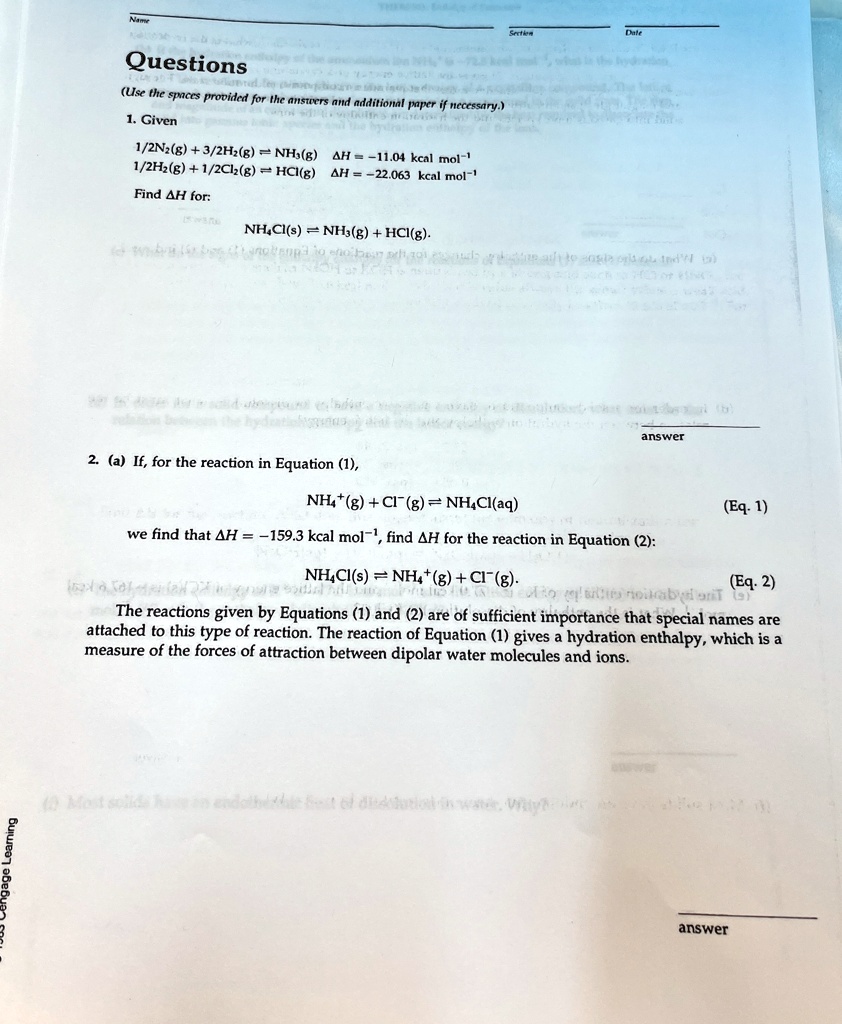
Questions
(Use the spaces provided for the answers and additional paper if necessary.)
1. Given
1/2N2(g) + 3/2H2(g) = NH3(g) ?H = -11.04 kcal mol?¹
1/2H2(g) + 1/2Cl2(g) = HCl(g) ?H = -22.063 kcal mol?¹
Find ?H for:
NH4Cl(s) = NH3(g) + HCl(g).
answer
2. (a) If, for the reaction in Equation (1),
NH4+(g) + Cl?(g) = NH4Cl(aq)
we find that ?H = -159.3 kcal mol?¹, find ?H for the reaction in Equation (2):
NH4Cl(s) = NH4+(g) + Cl?(g).
(Eq. 1)
(Eq. 2)
The reactions given by Equations (1) and (2) are of sufficient importance that special names are
attached to this type of reaction. The reaction of Equation (1) gives a hydration enthalpy, which is a
measure of the forces of attraction between dipolar water molecules and ions.
answer