Ace - AI Tutor
Ask Our Educators
Textbooks
My Library
Flashcards
Scribe - AI Notes
Notes & Exams
Download App
kevin yu

kevin y.

Divider

Questions asked

BEST MATCH

In dissociative identity disorder, the host personality usually O becomes of a gender opposite to that of the individual. O experiences amnesia during the time the other identities are present. O is the leader of the multiple identities. O is aware of each personality and everything happening while each personality is active.

View Answer
divider
BEST MATCH

Which of the following is an electron donor in chemoautotrophs? CO$_2$ H$_2$S NO$_3$$^{-2}$ SO$_4$$^{-2}$ All of the above

View Answer
divider
BEST MATCH

3.41 Apply mesh analysis to find $i$ in Fig. 3.87. 10 ? ww $i_1$ 6 V 2? +- $i$ 1? 4? $i_2$ $i_3$ 5? + 8 V

View Answer
divider
BEST MATCH

A patient in the ICU is receiving an IV antibiotic Tobramycin for a systemic infection. The reported level is 0.5 g/mL. How would you convert this to a different unit of umol/L? (The MW of Tobramycin is 467.52)

View Answer
divider
BEST MATCH

27 Given: PR = PS; \overrightarrow{RV} bisects \angle PRS. \overrightarrow{SV} bisects \angle PST. Prove: m\angle V = \frac{1}{2}(m\angle P) (Hint: Let m\angle P = 4x.)

View Answer
divider
BEST MATCH

1. Show work to justify answers. N? = 50 0.1 0.1 ?r = ? i? ? x N? = 100 ? × 10?³ The cross-sectional area is the same throughout. Neglect fringing and leakage flux (R?? = R?? = ?). i? = 5 A, i? = 0 (a) ?? = ______ SI units = ______ (b) Maximum flux density inside core, |B| = ______ SI units = ______ (c) L?? = ______ H (d) L?? = ______ H (e) If i? = 5 A as before and i? = 1 A, ?? = ______

View Answer
divider
BEST MATCH

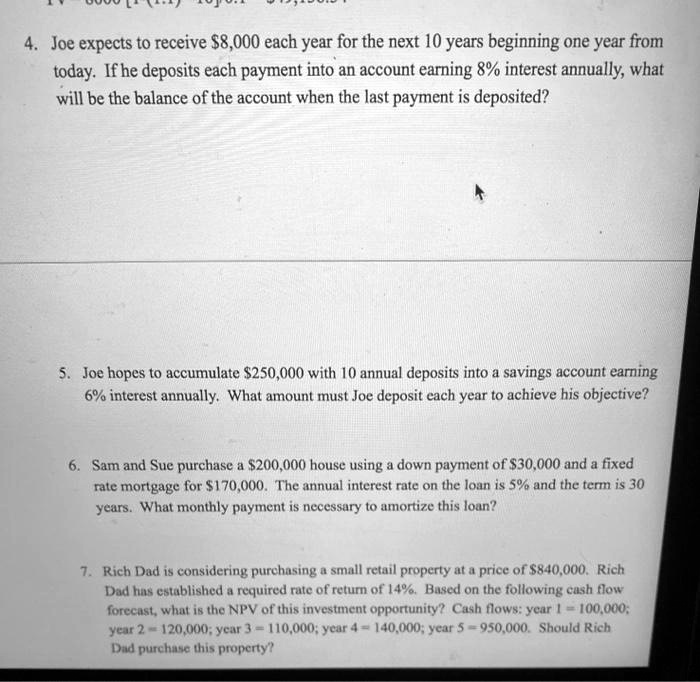
4. Joe expects to receive $8,000 each year for the next 10 years beginning one year from today. If he deposits each payment into an account earning 8% interest annually, what will be the balance of the account when the last payment is deposited? 5. Joe hopes to accumulate $250,000 with 10 annual deposits into a savings account earning 6% interest annually. What amount must Joe deposit each year to achieve his objective? 6. Sam and Sue purchase a $200,000 house using a down payment of $30,000 and a fixed rate mortgage for $170,000. The annual interest rate on the loan is 5% and the term is 30 years. What monthly payment is necessary to amortize this loan? 7. Rich Dad is considering purchasing a small retail property at a price of $840,000. Rich Dad has established a required rate of return of 14%. Based on the following cash flow forecast, what is the NPV of this investment opportunity? Cash flows: year 1 = 100,000; year 2 = 120,000; year 3 = 110,000; year 4 = 140,000; year 5 = 950,000. Should Rich Dad purchase this property?
View Answer
divider
BEST MATCH

Problem 10.3 - Temperature Distribution in a Sphere Consider a sphere of radius R. The temperature inside the sphere is again given by a heat equation. a) Perform a separation of variables u,t=S)Tt on the heat equation to get two differential equations - an ordinary ODE for time and a PDE for space. Let the separation constant for time again be c^2 and solve for the time function. The space equation should be in the form of a Helmholtz equation: ∇^2u = (1/r^2) ∂/∂r(r^2 ∂u/∂r) + (1/r^2 sin^2θ) ∂^2u/∂θ^2 + (1/r^2 sinθ ∂/∂θ(sinθ ∂u/∂θ)) = 0 b) Perform a separation of variables in spherical coordinates u=RrY to separate out the radial and angular independent variables in the Laplace equation. You should wind up with an ODE for R(r) and a PDE for Y(θ). Hint: We want to manipulate the equation so that each term only depends on one variable. Here, we want terms that only depend on r and terms that only depend on the angle θ. Let the separation coefficient for the radial ODE be λ(λ+1), where λ is a non-negative integer (This weird form of the separation constant is due to a quantization condition when solving the angular equation). The radial equation should then be: r^2 R'' + 2rR' - λ(λ+1)R = 0 This is a Euler-Cauchy-type problem! c) Change the independent variable from x = ln(r) and then solve using whatever method you would like to find the two linearly independent solutions to this equation. You can use physical considerations (the temperature doesn't diverge to infinity anywhere in the sphere!) to eliminate one of the two solutions. d) Suppose we have a spherically symmetric setup (so that the solution to the angular equation is just Y(θ) = 1). Write down the generic steady-state solution to the steady-state heat equation given your previous answers. What if we have axially symmetric solutions so Y(θ) = P(cosθ)?

View Answer
divider
BEST MATCH

4. For the given transistor circuit, draw the load line on the graph. a. Mark the location of Q-point for $I_B = 8\mu A$. b. What is the approximate value of $\beta$? c. What is the approximate level of $I_B$ that saturates the transistor?

View Answer
divider
BEST MATCH

Use superposition to find current $I_o$. (Only draw the sub-circuits and mark the corresponding variables to be solved) 6 k$\Omega$ 6 k$\Omega$ 12 V 6 k$\Omega$ 12 mA 6 k$\Omega$ $I_o$ 6 mA 6 k$\Omega$ 12 V $I_o$ 6 k$\Omega$ 6 k$\Omega$ 6 mA

View Answer
divider