Ace - AI Tutor
Ask Our Educators
Textbooks
My Library
Flashcards
Scribe - AI Notes
Notes & Exams
Download App
kevin young

kevin y.

Divider

Questions asked

BEST MATCH

Question 4 (21 points) Muscle tissue is represented by several types. Choose all that apply. Skeletal Multinuclear Smooth Striated Cardiac

View Answer
divider
BEST MATCH

Assign a point group to each member in the series (a) NHCl2, (b) C2H2, (c) CO, (d) BF3 (e) CBr4.

View Answer
divider
BEST MATCH

Canadian Investment Funds Course Exam - JONATHAN A OSORIO MARQUEZ Comment Calculator Scratch Pad Time Remaining 07:15 93 of 100 Bag for Review Bernadette has a high-paying job and is in the top tax bracket. She recently received a payment of $5 million upon the settlement of her uncle's estate. Bernadette would like to invest her inheritance in financial products that would not only grow her money but is also income tax friendly. Which of the following would provide the most favourable tax treatment? A O Coupon payments from Government of Canada bonds. B O Dividends received from a large foreign corporation. C O Capital gains from stock investments. D O Dividends from a large public Canadian corporation.

View Answer
divider
BEST MATCH

Valuation of investment securities, deprecation, and net realizable value of accounts receivable are all examples of

View Answer
divider
BEST MATCH

The United States formally ended its involvement with the Bracero Guest Worker program in the 1980's when President Ronald Regan granted amnesty to the illegal immigrants living in the country. No answer text provided. O False No answer text provided. O True

View Answer
divider
BEST MATCH

Question: Black and Hispanic populations faced disproportionate rates of eviction during COVID. True or False? Question 5: False experts are employed by companies to produce "doubts" and "create uncertainty" around the science behind policies, like the oil and gas industry. True or false.

View Answer
divider
BEST MATCH

District district_no district_name address zip_code commander email phone fax tty twitter FBI_Code fbi_code_no title description crime_against Community_Area community_area_no community_area_name side population Crime report_no case_number date block iucr_no location_description arrest domestic beat district_no ward_no fbi_code_no community_area_no latitude longitude location IUCR iucr_no primary_description secondary_description index_code Ward ward_no alderman_first_name alderman_last_name alderman_name_suffix ward_office_address ward_office_zip ward_email ward_office_phone ward_office_fax city_hall_office_room city_hall_office_phone city_hall_office_fax population Neighborhood neighborhood_name community_area_no

View Answer
divider
BEST MATCH

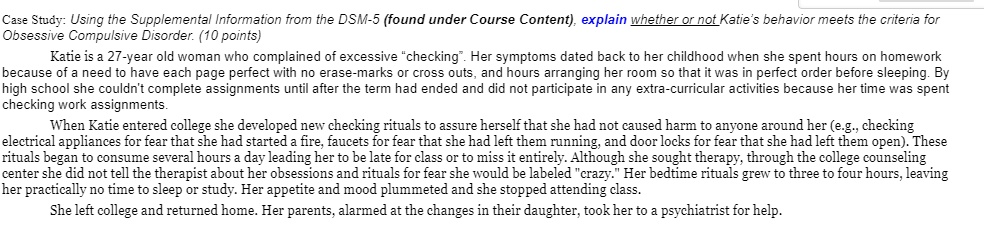
Case Study: Using the Supplemental Information from the DSM-5 (found under Course Content), explain whether or not Katie's behavior meets the criteria for Obsessive Compulsive Disorder. (10 points) Katie is a 27-year old woman who complained of excessive "checking". Her symptoms dated back to her childhood when she spent hours on homework because of a need to have each page perfect with no erase-marks or cross outs, and hours arranging her room so that it was in perfect order before sleeping. By high school she couldn't complete assignments until after the term had ended and did not participate in any extra-curricular activities because her time was spent checking work assignments. When Katie entered college she developed new checking rituals to assure herself that she had not caused harm to anyone around her (e.g., checking electrical appliances for fear that she had started a fire, faucets for fear that she had left them running, and door locks for fear that she had left them open). These rituals began to consume several hours a day leading her to be late for class or to miss it entirely. Although she sought therapy, through the college counseling center she did not tell the therapist about her obsessions and rituals for fear she would be labeled "crazy." Her bedtime rituals grew to three to four hours, leaving her practically no time to sleep or study. Her appetite and mood plummeted and she stopped attending class. She left college and returned home. Her parents, alarmed at the changes in their daughter, took her to a psychiatrist for help.
View Answer
divider
BEST MATCH

Suppose that: $C = c_0 + c_1(Y - T)$ $T = T_0$ $I = b_0 + b_1Y - b_2i$ $G = G_0$ Then the equation for the IS curve is: $\bigcirc Y = (1 - b_1 - c_1)(c_0 + b_0 + G_0 - c_1T_0) - b_2(1 - b_1 - c_1)i$ $\bigcirc Y = (1 - c_1)(c_0 + b_0 + G_0 - c_1T_0 - b_1) - b_2(1 - c_1)i$ $\bigcirc Y = \frac{1}{1 - b_1 - c_1}[c_0 + b_0 + G_0 - c_1T_0] - (\frac{b_2}{1 - b_1 - c_1})i$ $\bigcirc Y = \frac{1}{1 - c_1}[c_0 + b_0 + G_0 - c_1T_0 - b_1] - (\frac{b_2}{1 - c_1})i$

View Answer
divider
BEST MATCH

The present value of $10,000 to be received two years from today, assuming an interest rate of 4% is:

View Answer
divider