Texts:
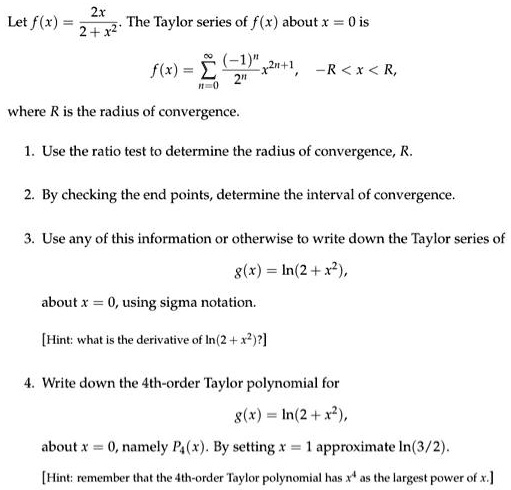
Let f(x) = 2x^2 + x^2. The Taylor series of f(x) about x = 0 is given by:
f(x) = Σ n=0 (-1)^n * (2n) * x^(2n)
where R is the radius of convergence. -R < x < R.
1. Use the ratio test to determine the radius of convergence, R.
2. By checking the end points, determine the interval of convergence.
3. Use any of this information or otherwise to write down the Taylor series of g(x) = ln(2 + x^2), about x = 0, using sigma notation. [Hint: what is the derivative of ln(2+x^2)?]
4. Write down the 4th-order Taylor polynomial for g(x) = ln(2 + x^2), about x = 0, namely P4(x). By setting x = 1, approximate ln(3/2). [Hint: remember that the 4th-order Taylor polynomial has x^4 as the largest power of x.]
The Taylor series of f(x) about x = 0 is 2x. The radius of convergence, R, can be determined using the ratio test.
By checking the end points, we can determine the interval of convergence.
Using this information, we can write down the Taylor series of g(x) = ln(2 + x^2), about x = 0, using sigma notation. [Hint: the derivative of ln(2+x^2) is 2x/(2+x^2)]
We can also write down the 4th-order Taylor polynomial for g(x) = ln(2 + x^2), about x = 0, namely P4(x). By setting x = 1, we can approximate ln(3/2). [Hint: the 4th-order Taylor polynomial has x^4 as the largest power of x.]