INFOGRAPHIC 9.1
Theories of Motivation
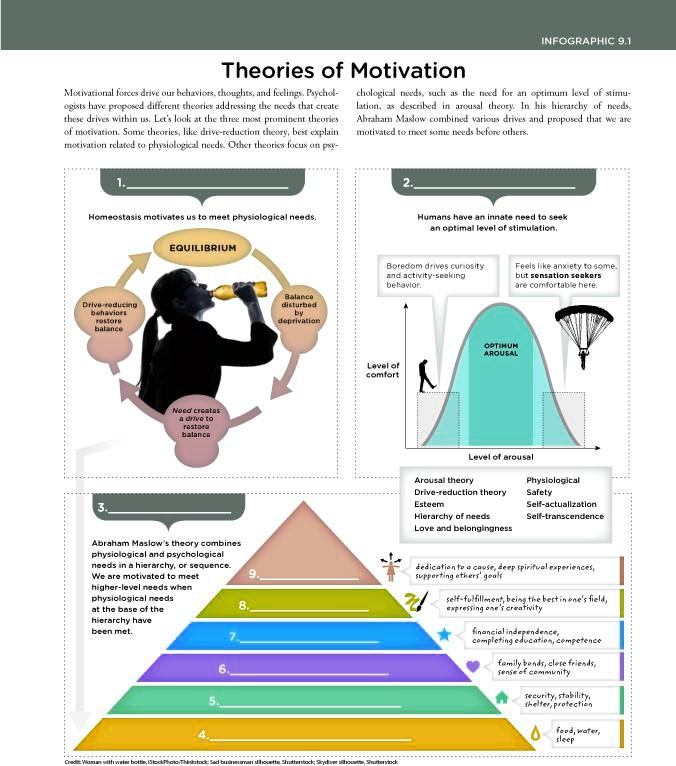
Motivational forces drive our behaviors, thoughts, and feelings. Psychologists have proposed different theories addressing the needs that create these drives within us. Let's look at the three most prominent theories of motivation. Some theories, like drive-reduction theory, best explain motivation related to physiological needs. Other theories focus on psychological needs, such as the need for an optimum level of stimulation as described in arousal theory. In his hierarchy of needs, Abraham Maslow combined various drives and proposed that we are motivated to meet some needs before others.
Homeostasis motivates us to meet physiological needs.
Humans have an innate need to seek an optimal level of stimulation.
Boredom drives curiosity and activity-seeking behavior.
It feels like anxiety to some, but sensation seekers are comfortable here.
Drive-reducing behaviors restore balance.
Equilibrium is created by deprivation.
Arousal theory.
Drive-reduction theory.
Esteem.
Hierarchy of needs.
Love and belongingness.
Physiological.
Safety.
Self-actualization.
Self-transcendence.
Abraham Maslow's theory combines physiological and psychological needs in a hierarchy, or sequence. We are motivated to meet higher-level needs when physiological needs at the base of the hierarchy have been met.
Dedication to a cause, deep spiritual experiences, supporting others' goals.
Self-fulfillment, being the best in one's field, expressing one's creativity.
Financial independence.
Family bonds, close friends, sense of community.
Security, stability, shelter, protection.
Food, water, sleep.