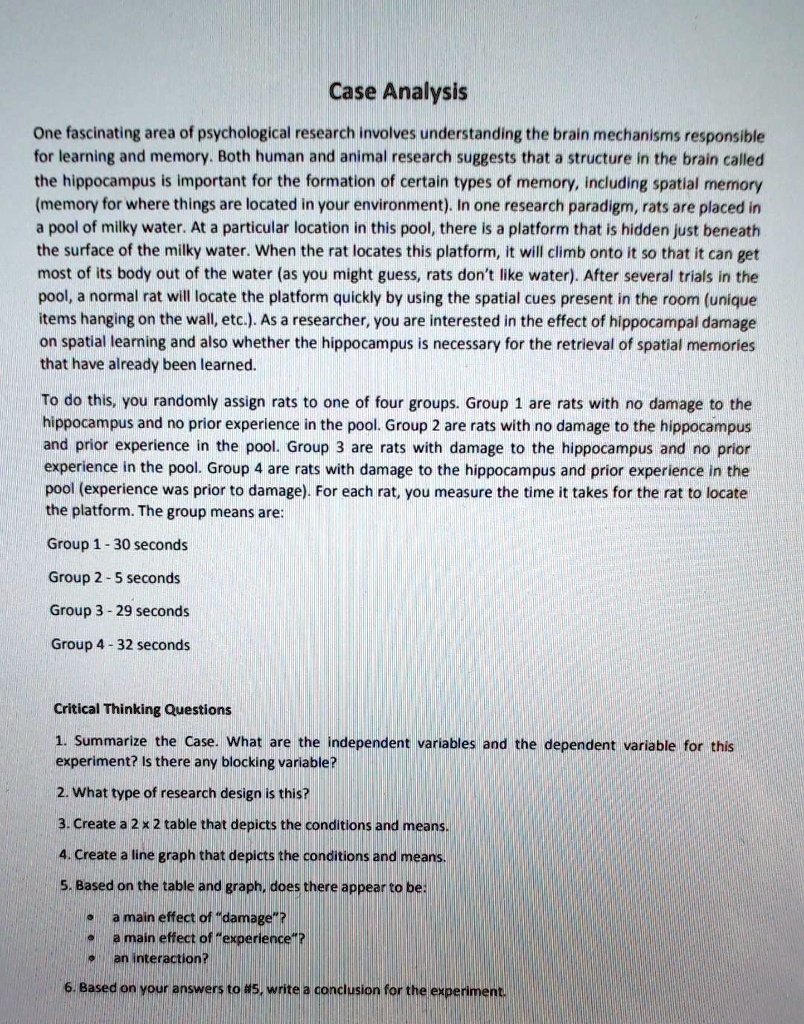
One fascinating area of psychological research involves understanding the brain mechanisms responsible for learning and memory. Both human and animal research suggests that a structure in the brain called the hippocampus plays a crucial role in spatial memory (memory for where things are located in your environment). In one research paradigm, rats are placed in a pool of milky water. At a particular location in this pool, there is a platform that is hidden just beneath the surface of the milky water. When the rat locates this platform, it will climb onto it so that it can get most of its body out of the water (as you might guess, rats don't like water). After several trials in the pool, a normal rat will locate the platform quickly by using the spatial cues present in the room (unique items hanging on the wall, etc.). As a researcher, you are interested in the effect of hippocampal damage on spatial learning and also whether the hippocampus is necessary for the retrieval of spatial memories that have already been learned.
To do this, you randomly assign rats to one of four groups. Group 1 consists of rats with no damage to the hippocampus and no prior experience in the pool. Group 2 consists of rats with no damage to the hippocampus and prior experience in the pool. Group 3 consists of rats with damage to the hippocampus and no prior experience in the pool. Group 4 consists of rats with damage to the hippocampus and prior experience in the pool (experience was prior to damage). For each rat, you measure the time it takes for the rat to locate the platform. The group means are as follows:
Group 1 - 30 seconds
Group 2 - 5 seconds
Group 3 - 29 seconds
Group 4 - 32 seconds
Critical Thinking Questions:
1. Summarize the Case. What are the independent variables and the dependent variable for this experiment? Is there any blocking variable?
2. What type of research design is this?
3. Create a 2x2 table that depicts the conditions and means.
4. Create a line graph that depicts the conditions and means.
5. Based on the table and graph, does there appear to be a main effect of damage, a main effect of experience, or an interaction?