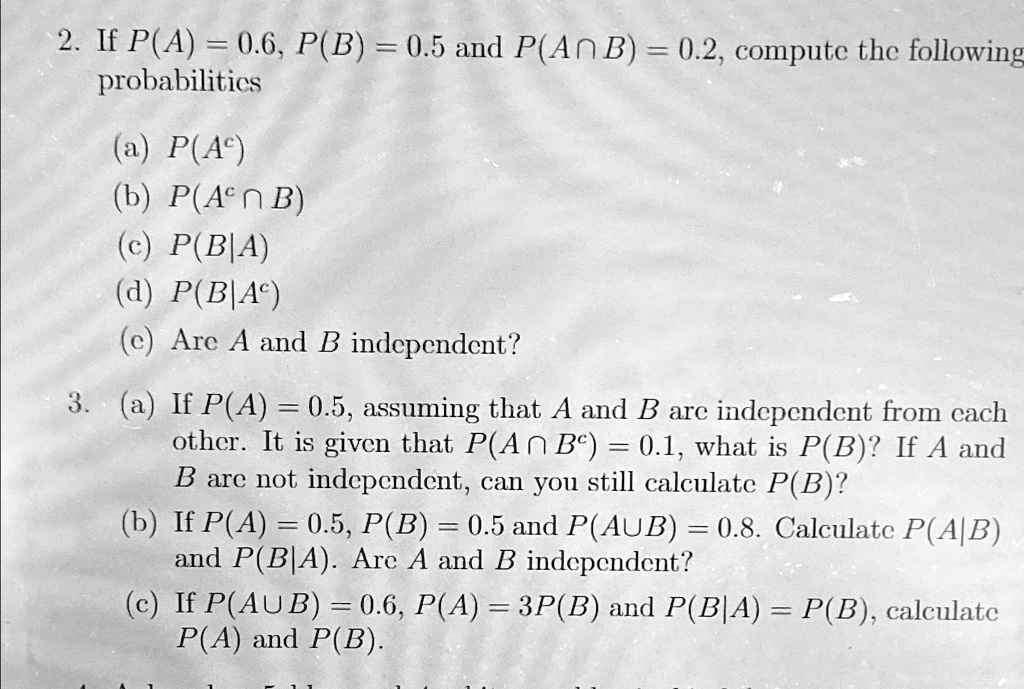
If P(A)=0.6, P(B)=0.5 and P(A∩B)=0.2, compute the following probabilities:
(a) P(A^c)
(b) P(A^c∩B)
(c) P(B|A)
(d) P(B|A^c)
(e) Are A and B independent?
(a) If P(A)=0.5, assuming that A and B are independent from each other. It is given that P(A∩B^c)=0.1, what is P(B)? If A and B are not independent, can you still calculate P(B)?
(b) If P(A)=0.5, P(B)=0.5 and P(A∪B)=0.8. Calculate P(A|B) and P(B|A). Are A and B independent?
(c) If P(A∪B)=0.6, P(A)=3P(B) and P(B|A)=P(B), calculate P(A) and P(B).
2. If P(A)=0.6, P(B)=0.5 and P(A∩B)=0.2, compute the following probabilities:
(a) P(A)
(b) P(A∩B)
(c) P(B|A)
(d) P(B|A)
(e) Are A and B independent?
3. (a) If P(A)=0.5, assuming that A and B are independent from each other. It is given that P(A∩B)=0.1, what is P(B)? If A and B are not independent, can you still calculate P(B)? (b) If P(A)=0.5, P(B)=0.5 and P(A∪B)=0.8. Calculate P(A|B) and P(B|A). Are A and B independent? (c) If P(A∪B)=0.6, P(A)=3P(B) and P(B|A)=P(B), calculate P(A) and P(B).