Problem 5.
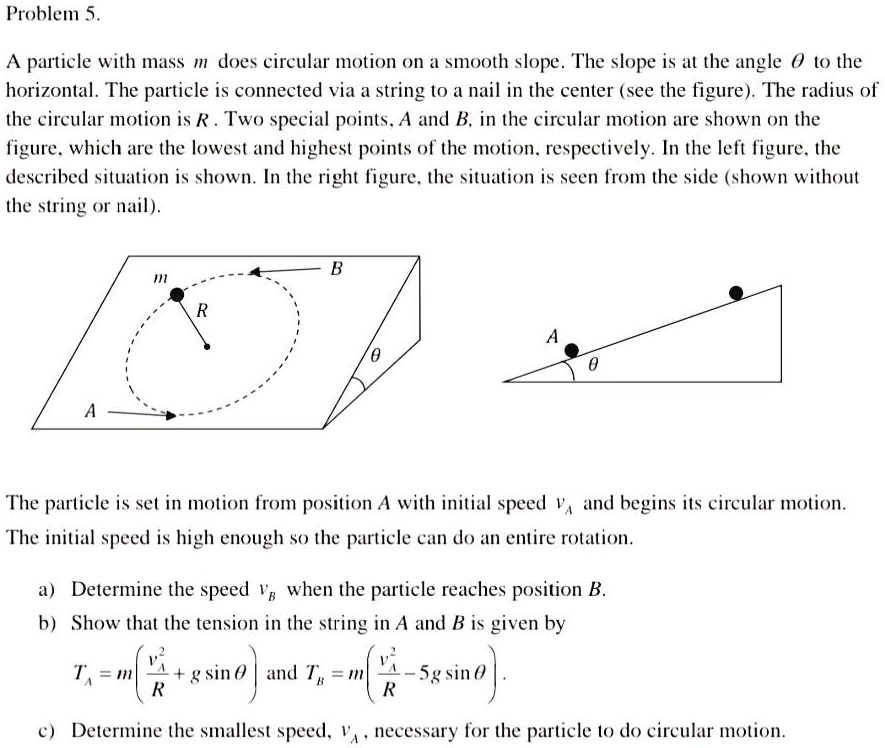
A particle with mass $m$ does circular motion on a smooth slope. The slope is at the angle $\theta$ to the
horizontal. The particle is connected via a string to a nail in the center (see the figure). The radius of
the circular motion is $R$. Two special points, A and B, in the circular motion are shown on the
figure, which are the lowest and highest points of the motion, respectively. In the left figure, the
described situation is shown. In the right figure, the situation is seen from the side (shown without
the string or nail).
The particle is set in motion from position A with initial speed $v_A$ and begins its circular motion.
The initial speed is high enough so the particle can do an entire rotation.
a) Determine the speed $v_B$ when the particle reaches position B.
b) Show that the tension in the string in A and B is given by
$T_A = m \left(\frac{v_A^2}{R} + g \sin \theta\right)$ and $T_B = m \left(\frac{v_A^2}{R} - 5g \sin \theta\right)$.
c) Determine the smallest speed, $v_A$, necessary for the particle to do circular motion.