1. All firms in the market produce an identical product.
2. A large number of firms (buyers and sellers) exist in the market so that no single firm dominates the market.
3. Each firm supplies only a very small portion of total output supplied to the market.
4. No barriers limit entry into or exit from the market, and firms and resources are fully mobile.
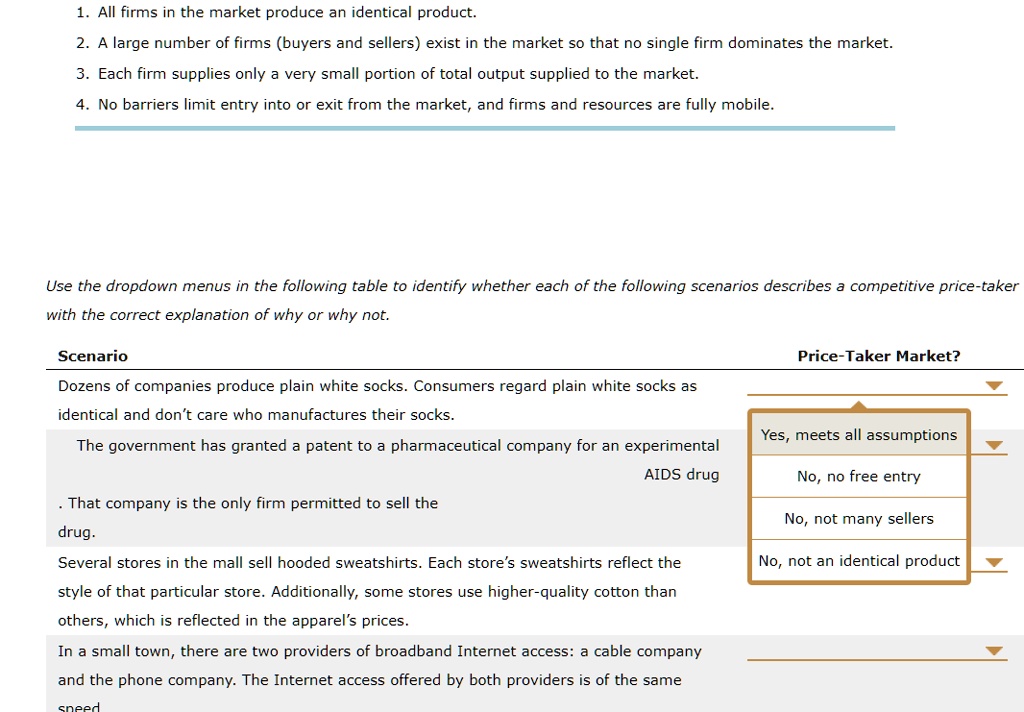
Use the dropdown menus in the following table to identify whether each of the following scenarios describes a competitive price-taker
with the correct explanation of why or why not.
Scenario
Dozens of companies produce plain white socks. Consumers regard plain white socks as
identical and don't care who manufactures their socks.
The government has granted a patent to a pharmaceutical company for an experimental
. That company is the only firm permitted to sell the
drug.
AIDS drug
Several stores in the mall sell hooded sweatshirts. Each store's sweatshirts reflect the
style of that particular store. Additionally, some stores use higher-quality cotton than
others, which is reflected in the apparel's prices.
In a small town, there are two providers of broadband Internet access: a cable company
and the phone company. The Internet access offered by both providers is of the same
speed
Price-Taker Market?
Yes, meets all assumptions
No, no free entry
No, not many sellers
No, not an identical product