Ace - AI Tutor
Ask Our Educators
Textbooks
My Library
Flashcards
Scribe - AI Notes
Notes & Exams
Download App
emily williams

emily w.

Divider

Questions asked

BEST MATCH

Question 3: [5 points] The 4:1 multiplexer is used to implement a Boolean function F(A,B,C). Derive and simplify the function “F”.

View Answer
divider
BEST MATCH

Regarding futures contracts, what does the word "margin" mean? Multiple Choice It is the maximum percentage that the price of the contract can change before it is marked to market. It is the amount of the money bomowed from the broker when you buy the contract It is a good-faith deposit made at the time of the contract's purchase or sale. It is the amount by which the contract is marked to market. It is the maximum percentage that the price of the underlying asset can change before it is marked to market.

View Answer
divider
BEST MATCH

For a For-Profit healthcare organization, which financial statement presents details related to the organization's value or Net Worth? Statement of Owner's Equity Changes in Net Assets Cash Flow Statement Income Statement

View Answer
divider
BEST MATCH

You begin preparation of the calibration curve to measure absorbance vs concentration of FeSCN2+. To do so, you add 3.062 mL of 0.200 M Fe(NO3)3 to a cuvette and then directly add 243 µL of 0.001 M KSCN. What is the resulting concentration of FeSCN2+, assuming complete conversion of SCN- to FeSCN2+? Enter your answer in units of mM to four digits after the decimal.

View Answer
divider
BEST MATCH

Obtain the value of \( (\sqrt{3}+1)^{6}+(\sqrt{3}-1)^{6} \) using binomial expansion method.

View Answer
divider
BEST MATCH

a population today (time 1), we should recapture that future census (time 2). This assumption leads to the following relationship: ( number marked at time 1)/( population size )=( number marked at time 2)/( total captured at time 2) We can re-arrange this equation as follows: population size =(( number marked at time 1) imes ( total captured at time 2))/( number marked at time 2) Fortunately, research drones routinely "mark" spotted gliders in the sanctuary with a GPS tag. Thus, for this analysis, a GPS-tagged glider is equivalent to a marked glider. My monitoring system shows a mean density of 270 GPS-tagged gliders per km2 (or 270km-2 ). Also, you and fellow explorers counted the number of tagged gliders and untagged gliders in a sample of the population. Collectively, you observed 59 untagged gliders and 42 tagged gliders. Therefore, you should be able to calculate the population size from the following information: the number of tagged gliders in the population (# Marked at time 1) the number of tagged gliders in your sample of the population (# Marked at time 2) the sum of tagged gliders and untagged gliders in your sample of the population (Total captured at time 2) Use the information and the formula above to calculate the population size for an area of 1km2. This population size for a given area represents the current density of spotted gliders. With this method you estimate that the current density of spotted gliders is 192.2 gliders per km2 212.1 gliders per km2 379.3 gliders per km2 649.3 gliders per km2 future census(time 2 This assumption leads to the following relationship: number marked at time 1 number marked at time 2 population size total captured at time 2 We can re-arrange this eguation as follows (number marked at time 1)x(total captured at time 2) population size number marked at time 2 for this analysis, a GPS-tagged glider is equivalent to a marked glider. My monitoring system shows a mean density of 270 GPS-tagged gliders per km2 (or 270 km-2) Also,you and fellow explorers counted the number of tagged gliders and untagged gliders in a sample of the population.Collectively,you observed 59 untagged gliders and 42 tagged gliders Therefore,you should be able to calculate the population size from the following information: 1. the number of tagged gliders in the population (# Marked at time 1) 2.the number of tagged gliders in your sample of the population (# Marked at time 2) 3. the sum of tagged gliders and untagged gliders in your sample of the population (Total captured at time 2) Use the information and the formula above to calculate the population size for an area of 1 km2 This population size for a given area represents the current density of spotted gliders. With this method you estimate that the current density of spotted gliders is O192.2 gliders per km2 O212.1 gliders per km2 O379.3gliders per km2 O649.3 gliders per km2

View Answer
divider
BEST MATCH

The value of China's exports of automobiles and parts (in billions of dollars) is approximately \(f(x) = 1.8208e^{0.3387x}\), where \(x = 0\) corresponds to 1998. In what year did/will the exports reach $7.2 billion?

View Answer
divider
BEST MATCH

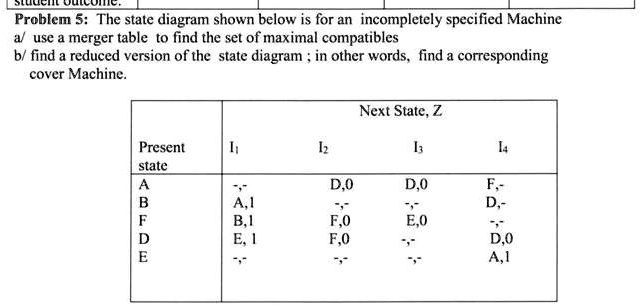
Problem 5: The state diagram shown below is for an incompletely specified Machine a/ use a merger table to find the set of maximal compatibles b/ find a reduced version of the state diagram; in other words, find a corresponding cover Machine. Next State, Z Present I1 I2 I3 I4 state A -- D,0 D,0 F, -- B A,1 -- -- D, -- F B,1 F,0 E,0 -- D E, 1 F,0 -- D,0 E -- -- -- A,1
View Answer
divider
BEST MATCH

Answer the following questions regarding the sample tree provided in Figure 4. 4 6 11 19 8 17 43 5 10 31 49 Figure 4: A sample tree (Question A4) a) The root node is (1 mark) b) Identify TWO (2) leaves. (2 marks) c) 17 and 43 are at level of the tree. (2 marks) d) Can the tree in Figure 4 be considered a complete binary tree? (1 marks) e) Justify your answer in d). (3 marks) f) List the nodes in the pre-order traversal. (3 marks) a) List the nodes in the post-order traversal

View Answer
divider
BEST MATCH

Find the next two terms of the sequence 5, 8, 11, 14, 17,...

View Answer
divider