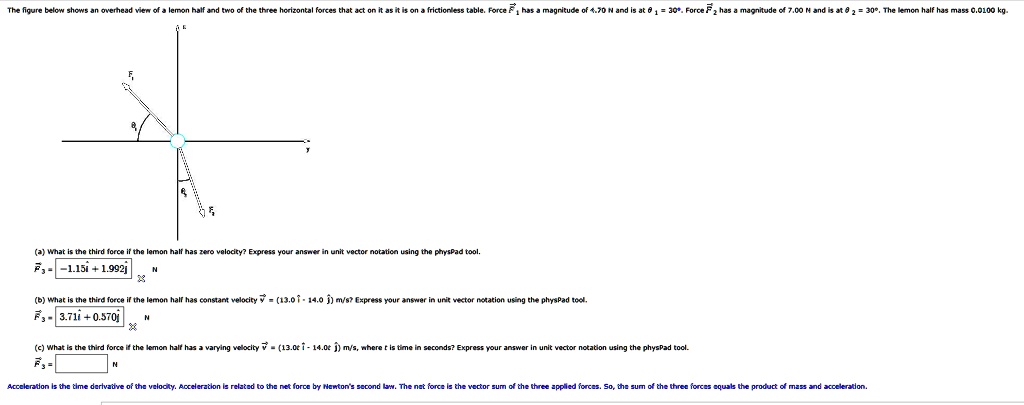
The figure below shows an overhead view of a lemon half and two of the three horizontal forces that act on it as it is on a frictionless table. Force $$\vec{F_1}$$ has a magnitude of 4.70 N and is at $$\theta_1 = 30^\circ$$. Force $$\vec{F_2}$$ has a magnitude of 7.00 N and is at $$\theta_2 = 30^\circ$$. The lemon half has mass 0.0100 kg.
(a) What is the third force if the lemon half has zero velocity? Express your answer in unit vector notation using the physPad tool.
$$\vec{F_3} = -1.15\hat{i} + 1.99\hat{j}$$ N
(b) What is the third force if the lemon half has constant velocity $$\vec{v} = (13.0\hat{i} - 14.0\hat{j})$$ m/s? Express your answer in unit vector notation using the physPad tool.
$$\vec{F_3} = 3.71\hat{i} + 0.570\hat{j}$$ N
(c) What is the third force if the lemon half has a varying velocity $$\vec{v} = (13.0t\hat{i} - 14.0\hat{j})$$ m/s, where t is time in seconds? Express your answer in unit vector notation using the physPad tool.
$$\vec{F_3} =$$ N
Acceleration is the time derivative of the velocity. Acceleration is related to the net force by Newton's second law. The net force is the vector sum of the three applied forces. So, the sum of the three forces equals the product of mass and acceleration.