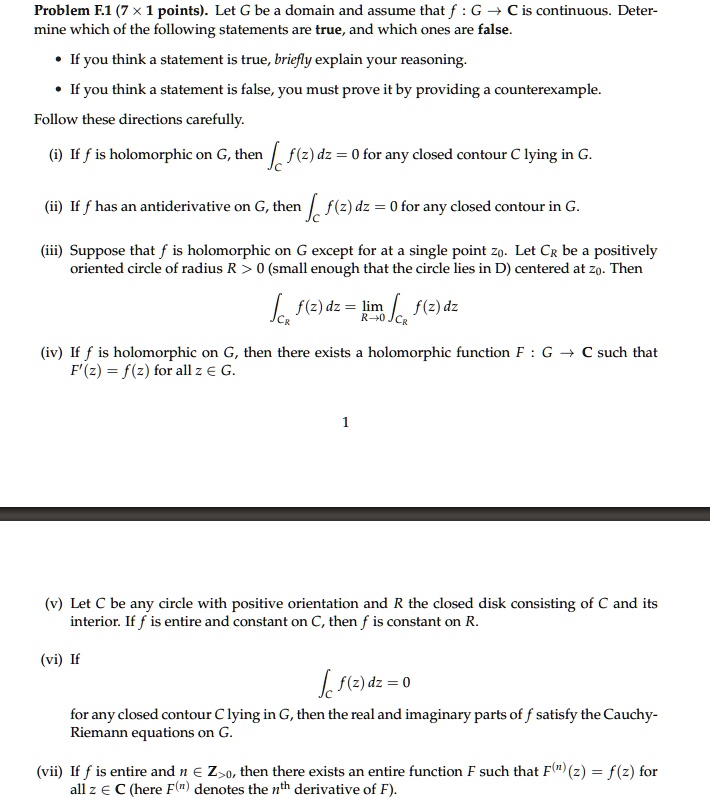
Problem F.1 (7 × 1 points). Let G be a domain and assume that $f: G \to \mathbb{C}$ is continuous. Determine which of the following statements are true, and which ones are false.
• If you think a statement is true, briefly explain your reasoning.
• If you think a statement is false, you must prove it by providing a counterexample.
Follow these directions carefully.
(i) If $f$ is holomorphic on $G$, then $\int_C f(z) \, dz = 0$ for any closed contour $C$ lying in $G$.
(ii) If $f$ has an antiderivative on $G$, then $\int_C f(z) \, dz = 0$ for any closed contour in $G$.
(iii) Suppose that $f$ is holomorphic on $G$ except for at a single point $z_0$. Let $C_R$ be a positively oriented circle of radius $R > 0$ (small enough that the circle lies in $D$) centered at $z_0$. Then
$\int_{C_R} f(z) \, dz = \lim_{R \to 0} \int_{C_R} f(z) \, dz$
(iv) If $f$ is holomorphic on $G$, then there exists a holomorphic function $F: G \to \mathbb{C}$ such that $F'(z) = f(z)$ for all $z \in G$.
(v) Let $C$ be any circle with positive orientation and $R$ the closed disk consisting of $C$ and its interior. If $f$ is entire and constant on $C$, then $f$ is constant on $R$.
(vi) If
$\int_C f(z) \, dz = 0$
for any closed contour $C$ lying in $G$, then the real and imaginary parts of $f$ satisfy the Cauchy-Riemann equations on $G$.
(vii) If $f$ is entire and $n \in \mathbb{Z}_{>0}$, then there exists an entire function $F$ such that $F^{(n)}(z) = f(z)$ for all $z \in \mathbb{C}$ (here $F^{(n)}$ denotes the $n^{th}$ derivative of $F$).