Texts: Problem 2
NO is a gas that is emitted all across the globe from automobile and smokestack emissions. NO is harmful to the environment in many ways: it causes photochemical smog, affects lung function, and contributes to acidification of rain, which causes changes in global ocean pH and rapidly changes ecosystems.
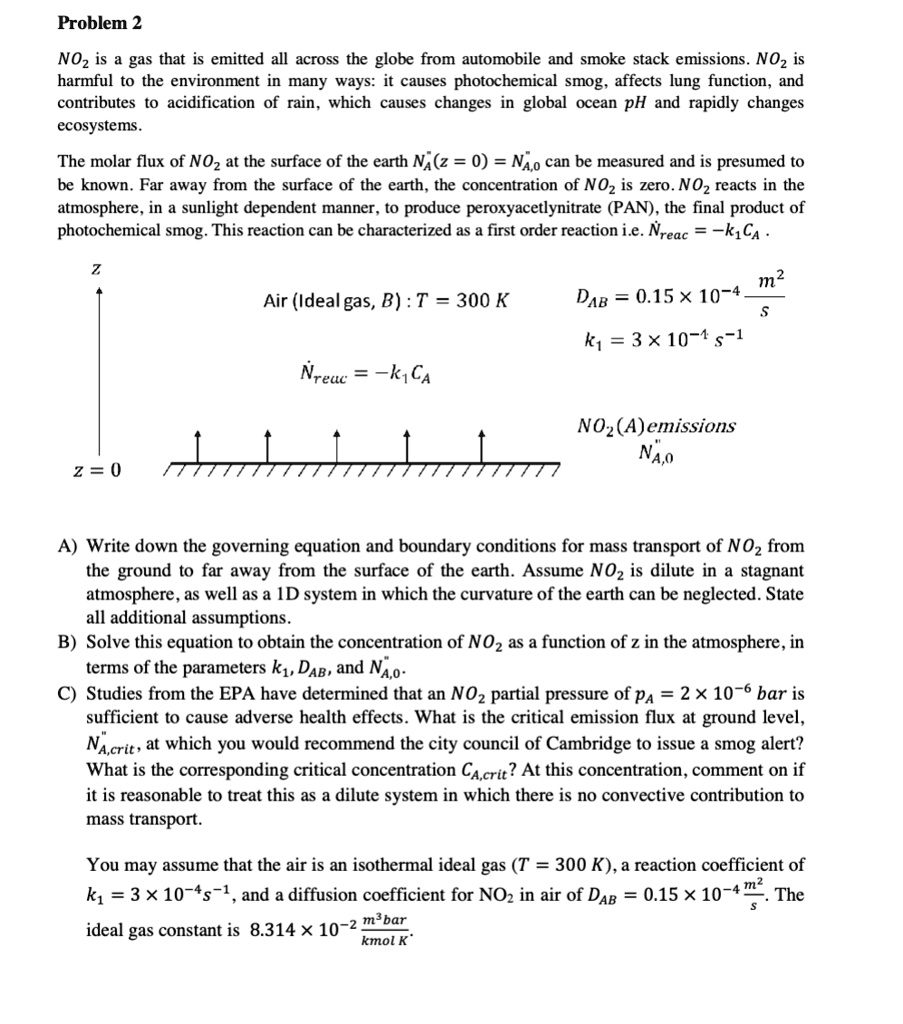
The molar flux of NO at the surface of the earth N(z = 0) = NA·o can be measured and is presumed to be known. Far away from the surface of the earth, the concentration of NO is zero. NO reacts in the atmosphere, in a sunlight-dependent manner, to produce peroxyacetyl nitrate (PAN), the final product of photochemical smog. This reaction can be characterized as a first-order reaction, i.e. Nreac = -kCa.
Air (Ideal gas, B): T = 300 K, S k = 3 x 10^-4 s^-1, Nreuc = -kqCA, NO2 (A) emissions NA,o, z = 0.
A) Write down the governing equation and boundary conditions for mass transport of NO from the ground to far away from the surface of the earth. Assume NO is dilute in a stagnant atmosphere, as well as a 1D system in which the curvature of the earth can be neglected. State.
B) Solve this equation to obtain the concentration of NO as a function of z in the atmosphere, in terms of the parameters k1, DAB, and NA,o.
C) Studies from the EPA have determined that an NO2 partial pressure of pA = 2 x 10^-6 bar is sufficient to cause adverse health effects. What is the critical emission flux at ground level, NA,crit, at which you would recommend the city council of Cambridge to issue a smog alert? What is the corresponding critical concentration Ca,crit? At this concentration, comment on if it is reasonable to treat this as a dilute system in which there is no convective contribution to mass transport.
You may assume that the air is an isothermal ideal gas (T = 300 K), a reaction coefficient of kmol K.