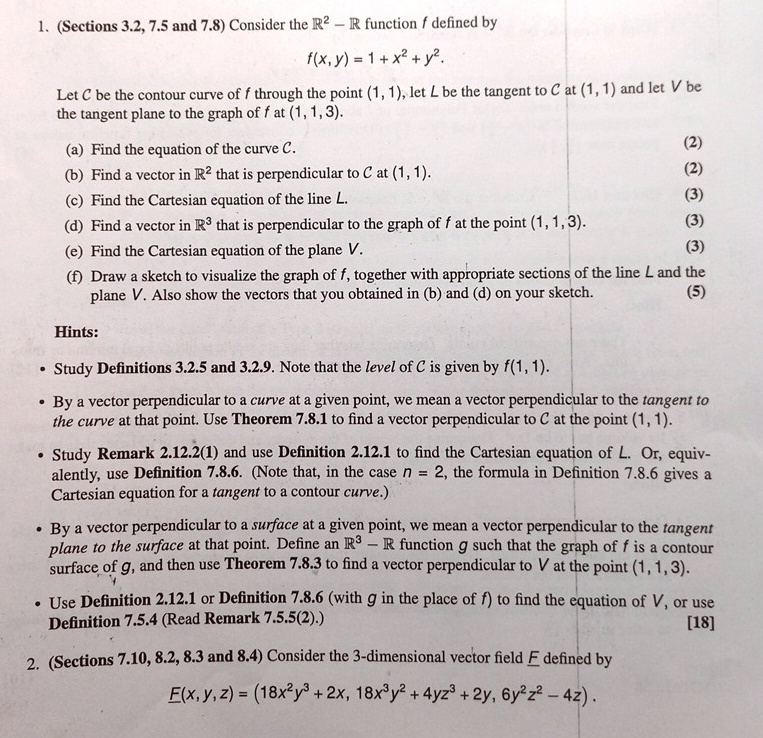
1. (Sections 3.2, 7.5 and 7.8) Consider the R² → R function f defined by
$$f(x, y) = 1 + x^2 + y^2.$$
Let C be the contour curve of f through the point (1, 1), let L be the tangent to C at (1, 1) and let V be
the tangent plane to the graph of f at (1, 1, 3).
(a) Find the equation of the curve C.
(2)
(b) Find a vector in R² that is perpendicular to C at (1, 1).
(2)
(c) Find the Cartesian equation of the line L.
(3)
(d) Find a vector in R³ that is perpendicular to the graph of f at the point (1, 1, 3).
(3)
(e) Find the Cartesian equation of the plane V.
(3)
(f) Draw a sketch to visualize the graph of f, together with appropriate sections of the line L and the
plane V. Also show the vectors that you obtained in (b) and (d) on your sketch.
(5)
Hints:
• Study Definitions 3.2.5 and 3.2.9. Note that the level of C is given by f(1, 1).
• By a vector perpendicular to a curve at a given point, we mean a vector perpendicular to the tangent to
the curve at that point. Use Theorem 7.8.1 to find a vector perpendicular to C at the point (1, 1).
• Study Remark 2.12.2(1) and use Definition 2.12.1 to find the Cartesian equation of L. Or, equiv-
alently, use Definition 7.8.6. (Note that, in the case n = 2, the formula in Definition 7.8.6 gives a
Cartesian equation for a tangent to a contour curve.)
• By a vector perpendicular to a surface at a given point, we mean a vector perpendicular to the tangent
plane to the surface at that point. Define an IR³ - IR function g such that the graph of f is a contour
surface of g, and then use Theorem 7.8.3 to find a vector perpendicular to V at the point (1, 1, 3).
• Use Definition 2.12.1 or Definition 7.8.6 (with g in the place of f) to find the equation of V, or use
Definition 7.5.4 (Read Remark 7.5.5(2).)
2. (Sections 7.10, 8.2, 8.3 and 8.4) Consider the 3-dimensional vector field F defined by
$$F(x, y, z) = (18x^2y^3 + 2x, 18x^3y^2 + 4yz^3 + 2y, 6y^2z^2 - 4z).$$
[18]