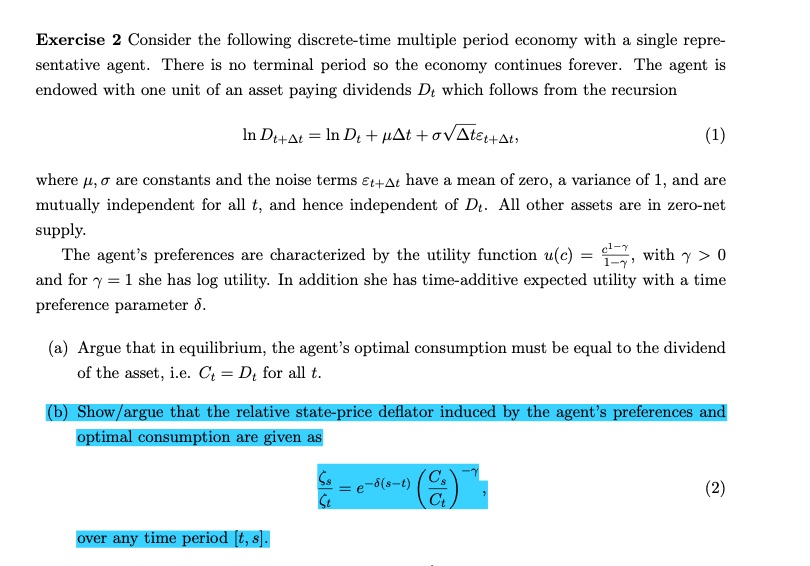
Exercise 2 Consider the following discrete-time multiple period economy with a single representative agent. There is no terminal period so the economy continues forever. The agent is endowed with one unit of an asset paying dividends $D_t$ which follows from the recursion
$\ln D_{t+\Delta t} = \ln D_t + \mu \Delta t + \sigma \sqrt{\Delta t} \epsilon_{t+\Delta t}$,
(1)
where $\mu$, $\sigma$ are constants and the noise terms $\epsilon_{t+\Delta t}$ have a mean of zero, a variance of 1, and are mutually independent for all t, and hence independent of $D_t$. All other assets are in zero-net supply.
The agent's preferences are characterized by the utility function $u(c) = \frac{c^{1-\gamma}}{1-\gamma}$, with $\gamma > 0$ and for $\gamma = 1$ she has log utility. In addition she has time-additive expected utility with a time preference parameter $\delta$.
(a) Argue that in equilibrium, the agent's optimal consumption must be equal to the dividend of the asset, i.e. $C_t = D_t$ for all t.
(b) Show/argue that the relative state-price deflator induced by the agent's preferences and optimal consumption are given as
$\frac{\zeta_s}{\zeta_t} = e^{-\delta(s-t)} \left(\frac{C_s}{C_t}\right)^{-\gamma}$,
(2)
over any time period $[t, s]$.