Ace - AI Tutor
Ask Our Educators
Textbooks
My Library
Flashcards
Scribe - AI Notes
Notes & Exams
Download App
ashley campos

ashley c.

Divider

Questions asked

BEST MATCH

Question No. 7: For the following hypothesis test: $H_0: \mu = 200$ $H_1: \mu \neq 200$ $\alpha = 0.01$ with $n = 64$, $\sigma = 9$, and $\bar{x} = 196.5$, compute the appropriate test statistic and state your conclusion.

View Answer
divider
BEST MATCH

What else can influence the formation of values in children? Give reasons to support this other view for the article our violent kids

View Answer
divider
BEST MATCH

A will does not need to comply with legal requirements that are intended to ensure that the wishes of the testator are met. True False

View Answer
divider
BEST MATCH

How does quantum tunneling impact the miniaturization of semiconductor devices in modern electronics, and what theoretical limits are imposed by quantum effects on transistor scaling?

View Answer
divider
BEST MATCH

146C (mass = 14.003242 u) undergoes beta decay to 147N (mass = 14.003074 u).(a) Write the complete decay formula for this process. (Enter elements and electrons with their atomic numbers and mass numbers; i.e.01e. Enter neutrinos and antineutrinos as .)chemPadHelp (b) Find the maximum kinetic energy of the emerging electrons. keV

View Answer
divider
BEST MATCH

Answer: b->a->c->d

View Answer
divider
BEST MATCH

An investment pays $3,000 at the beginning of years 3, 6, 9, 12, 15, 18 (i.e. 6 payments of $3,000 each). What is the PV as of today of these cash flows, if discounted at a nominal annual rate of 4% p.a. (rounded to the nearest $, do not type the $ sign)? You may want to draw a timeline and visualize the problem. QUESTION 57 ABC Company just paid out a dividend of $2 and expects this dividend to grow indefinitely at a rate of x% per year. ABC has 100,000 shares outstanding with a current market price of $26 per share. ABC's Beta is 1.5, the return on the market is 9%, and the risk-free rate is 3%. Calculate ABC's required rate of return, based on the CAPM. Show the result in %, 1 decimal place, do not type the % sign.

View Answer
divider
BEST MATCH

## Using the 'rrcov3way' package in R-Studio, solve the following: # 1. Use the dataset Kojima from the packagerrcov3way, read the description. # (a) Using the boys data, find the mean per each scale # (b) Using the boys data, find the mean per each judgment # (c) Using the boys data, Create a matrix where each row is a judgment, # each column is ascale and the values are the means for all the individuals. install.packages("rrcov3way") library(rrcov3way) data(Kojima)

View Answer
divider
BEST MATCH

a = hardlims (n) E4.10 The symmetric hard limit function is sometimes used in perceptron net-works, instead of the hard limit function. Target values are then takenfrom the set [-1, 1] instead of [0, 1]. i. Write a simple expression that maps numbers in the ordered set {0, 1] into the ordered set [-1,1]. Write the expression that performs the inverse mapping. Wp - b II. Consider two single-neuron perceptrons with the same weight and bias values. The first network uses the hard limit function ([0, 1] values), and the second network uses the symmetric hard limit func- tion. If the two networks are given the same input p, and updated with the perceptron learning rule, will their weights continue to have the same value? Dr. Lafta Al-Qaisy iii. If the changes to the weights of the two neurons are different, how do they differ? Why? 37 iv. Given initial weight and biss values for a standard hard limit per- ceptron, create a method for initializing a symmetric hard limit per- ceptron so that the two neurons will always respond identically when trained on identical data.

View Answer
divider
BEST MATCH

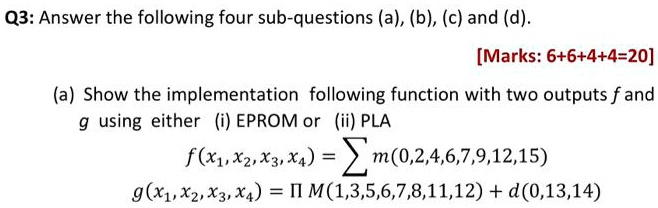
Q3: Answer the following four sub-questions (a), (b), (c) and (d). [Marks: 6+6+4+4=20] (a) Show the implementation following function with two outputs \textit{f} and \textit{g} using either (i) EPROM or (ii) PLA $f(x_1, x_2, x_3, x_4) = \sum m(0,2,4,6,7,9,12,15)$ $g(x_1, x_2, x_3, x_4) = \prod M(1,3,5,6,7,8,11,12) + d(0,13,14)$
View Answer
divider