Question 1
\(V_0\)
\(z = 0\)
\(\frac{L}{2}\)
\(c\)
\(z\)
\(a\)
\(b\)
\(\epsilon_2\)
\(z = L\)
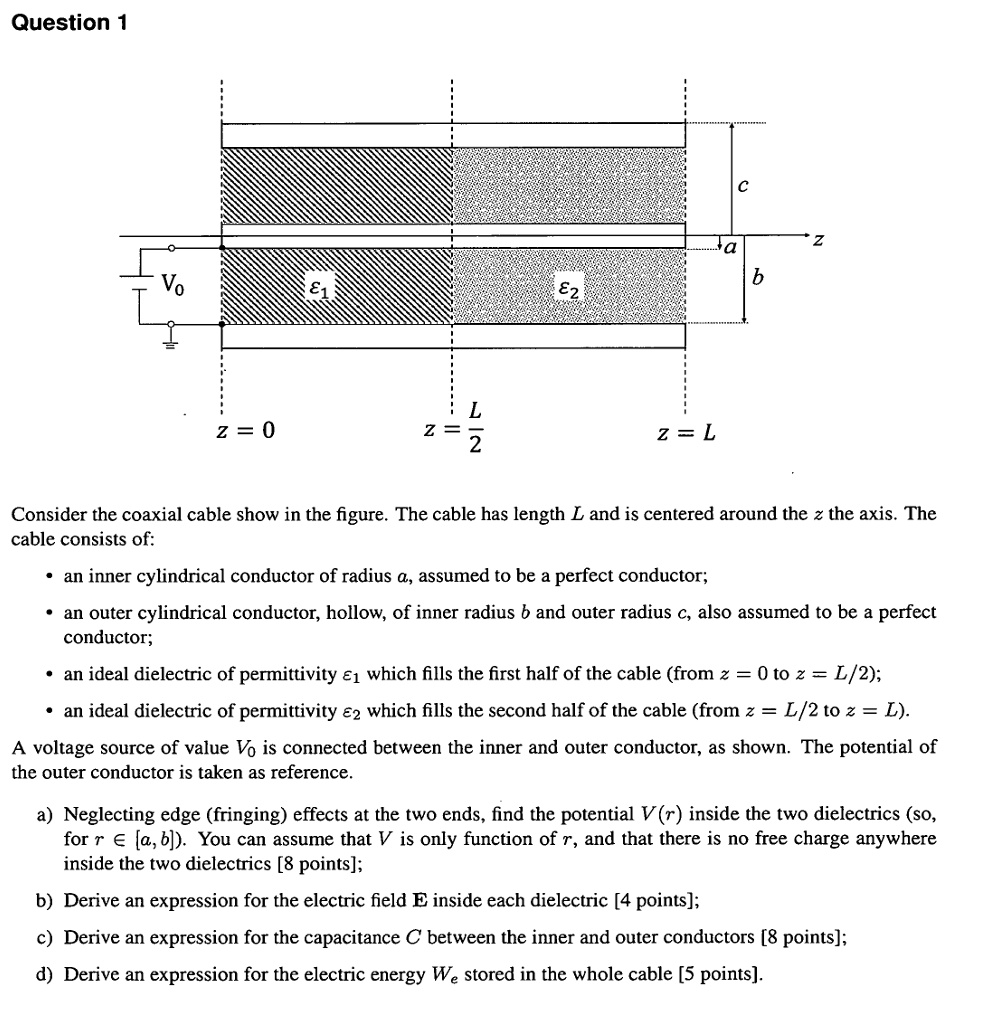
Consider the coaxial cable show in the figure. The cable has length \(L\) and is centered around the \(z\) the axis. The
cable consists of:
\begin{itemize}
\item an inner cylindrical conductor of radius \(a\), assumed to be a perfect conductor;
\item an outer cylindrical conductor, hollow, of inner radius \(b\) and outer radius \(c\), also assumed to be a perfect
conductor;
\item an ideal dielectric of permittivity \(\epsilon_1\) which fills the first half of the cable (from \(z = 0\) to \(z = L/2\));
\item an ideal dielectric of permittivity \(\epsilon_2\) which fills the second half of the cable (from \(z = L/2\) to \(z = L\)).
\end{itemize}
A voltage source of value \(V_0\) is connected between the inner and outer conductor, as shown. The potential of
the outer conductor is taken as reference.
a) Neglecting edge (fringing) effects at the two ends, find the potential \(V(r)\) inside the two dielectrics (so,
for \(r \in [a, b]\)). You can assume that \(V\) is only function of \(r\), and that there is no free charge anywhere
inside the two dielectrics [8 points];
b) Derive an expression for the electric field \(E\) inside each dielectric [4 points];
c) Derive an expression for the capacitance \(C\) between the inner and outer conductors [8 points];
d) Derive an expression for the electric energy \(W_e\) stored in the whole cable [5 points].