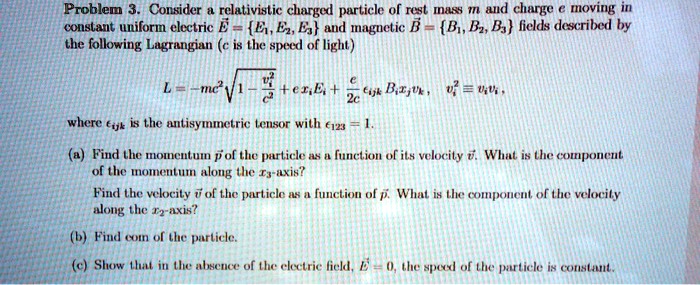
Problem 3. Consider a relativistic charged particle of rest mass m and charge e moving in
constant uniform electric \(\vec{E} = \{E_1, E_2, E_3\}\) and magnetic \(\vec{B} = \{B_1, B_2, B_3\}\) fields described by
the following Lagrangian (c is the speed of light)
\(L = -mc^2\sqrt{1 - \frac{v^2}{c^2}} + e \vec{x} \cdot \vec{E} + \frac{e}{2c} \epsilon_{ijk} B_i x_j v_k,\) \(v^2 = v_i v_i,\)
where \(\epsilon_{ijk}\) is the antisymmetric tensor with \(\epsilon_{123} = 1.\)
(a) Find the momentum \(\vec{p}\) of the particle as a function of its velocity \(\vec{v}\). What is the component
of the momentum along the \(x_3\)-axis?
Find the velocity \(\vec{v}\) of the particle as a function of \(\vec{p}\). What is the component of the velocity
along the \(x_2\)-axis?
(b) Find com of the particle.
(c) Show that in the absence of the electric field, \(\vec{E} = \vec{0}\), the speed of the particle is constant.