Exercise 12, Linear Algebra With Applications, 8th Edition
NEXT QUESTION
Step by step explanation
HIDE ALL
Tip
We will solve it by using the concept of eigen principle.
Explanation
Here, we have:
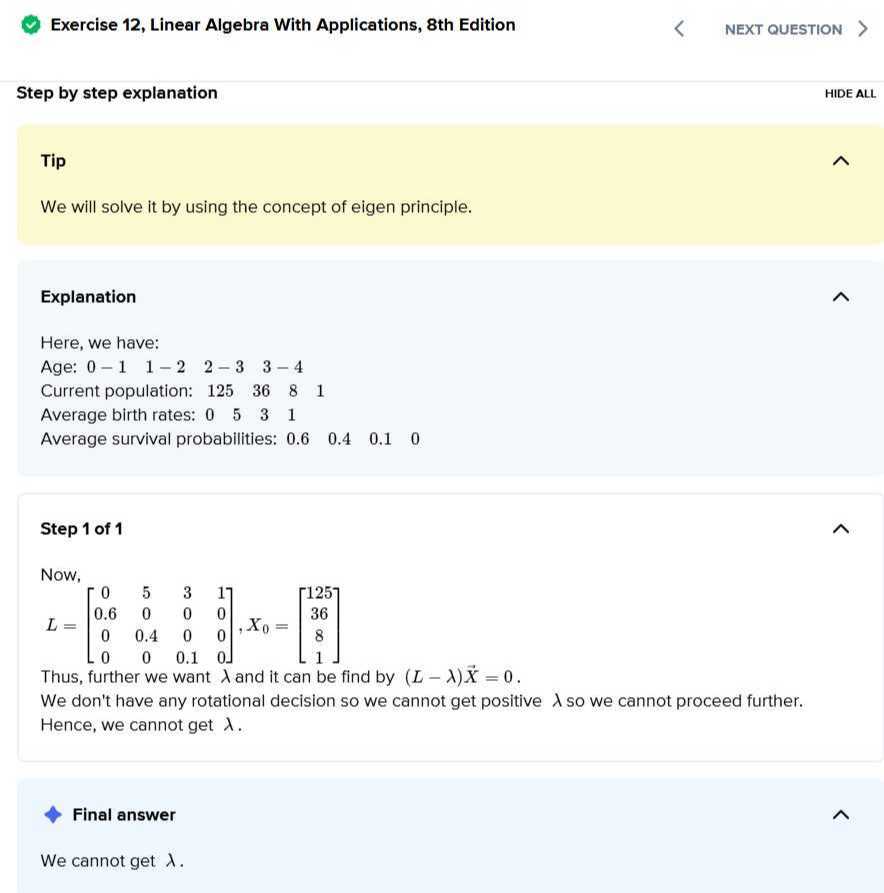
Age: \( 0-1 \quad 1-2 \quad 2-3 \quad 3-4 \)
Current population: \( \begin{array}{llll}125 & 36 & 8 & 1\end{array} \)
Average birth rates: \( \begin{array}{llll}0 & 5 & 3 & 1\end{array} \)
Average survival probabilities: \( \begin{array}{lllll}0.6 & 0.4 & 0.1 & 0\end{array} \)
Step 1 of 1
Now,
\[
L=\left[\begin{array}{cccc}
0 & 5 & 3 & 1 \\
0.6 & 0 & 0 & 0 \\
0 & 0.4 & 0 & 0 \\
0 & 0 & 0.1 & 0
\end{array}\right], X_{0}=\left[\begin{array}{c}
125 \\
36 \\
8 \\
1
\end{array}\right]
\]
Thus, further we want \( \lambda \) and it can be find by \( (L-\lambda) \vec{X}=0 \).
We don't have any rotational decision so we cannot get positive \( \lambda \) so we cannot proceed further. Hence, we cannot get \( \lambda \).
Final answer
We cannot get \( \lambda \).