Q6) (25 points) The differential ability of various tissues to scatter and absorb X-ray photons, no matter
by which mechanisms, is given by their linear attenuation coefficient (cm^(-1)), which expresses the
fractional reduction in beam intensity along a linear beam path after passage through one centimeter of
the tissue. Assume we are sending No photons to a homogeneous material with a thickness of x. The
material has a linear attenuation coefficient of mu . Neglect all the effects besides attenuation, such as
reflection, etc..
(a) (5 points) Assume that the number of photons that will be attenuated by the material is linearly
proportional to the number of incident photons (No), to the linear attenuation coefficient of the material
(mu ), and the thickness of the material (x). Starting from this assumption shows that, the number of
transmitted photons can be calculated using n(x)=NoExp(-mu x).
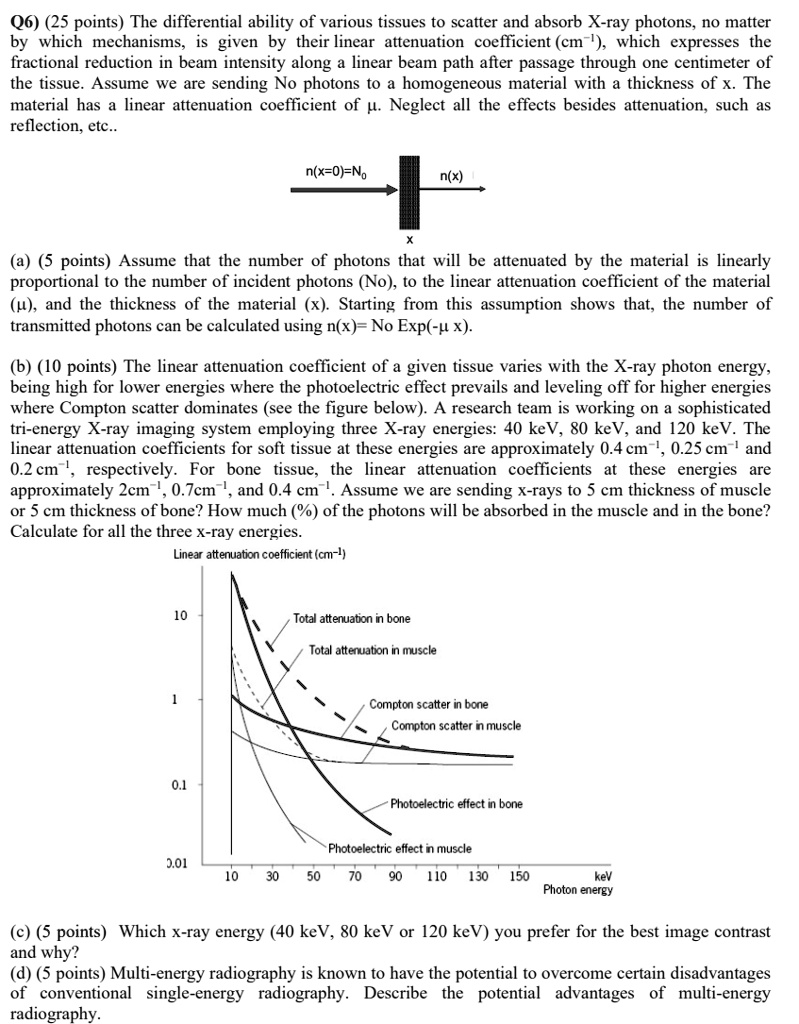
(b) (10 points) The linear attenuation coefficient of a given tissue varies with the X-ray photon energy,
being high for lower energies where the photoelectric effect prevails and leveling off for higher energies
where Compton scatter dominates (see the figure below). A research team is working on a sophisticated
tri-energy X-ray imaging system employing three X-ray energies: 40keV,80keV, and 120keV. The
linear attenuation coefficients for soft tissue at these energies are approximately 0.4cm^(-1),0.25cm^(-1) and
0.2cm^(-1), respectively. For bone tissue, the linear attenuation coefficients at these energies are
approximately 2cm^(-1),0.7cm^(-1), and 0.4cm^(-1). Assume we are sending x-rays to 5cm thickness of muscle
or 5cm thickness of bone? How much (%) of the photons will be absorbed in the muscle and in the bone?
Calculate for all the three x-ray energies.
(c) (5 points) Which x-ray energy (40 keV, 80keV or 120keV you prefer for the best image contrast
and why?
(d) (5 points) Multi-energy radiography is known to have the potential to overcome certain disadvantages
of conventional single-energy radiography. Describe the potential advantages of multi-energy
radiography.
Q6(25 points The differential ability of various tissues to scatter and absorb X-ray photons,no matter by which mechanisms, is given by their linear attenuation coefficient (cm-, which expresses the fractional reduction in beam intensity along a linear beam path after passage through one centimeter of the tissue. Assume we are sending No photons to a homogeneous material with a thickness of x. The material has a linear attenuation coefficient of u. Neglect all the effects besides attenuation, such as reflection, etc..
n(x=0)=No
n(x)
X
a) (5 points) Assume that the number of photons that will be attenuated by the material is linearly proportional to the number of incident photons (No), to the linear attenuation coefficient of the material (u), and the thickness of the material (x). Starting from this assumption shows that, the number of transmitted photons can be calculated using n(x)=No Exp(- x
(b) (10 points) The linear attenuation coefficient of a given tissue varies with the X-ray photon energy, being high for lower energies where the photoelectric effect prevails and leveling off for higher energies where Compton scatter dominates (see the figure below). A research team is working on a sophisticated tri-energy X-ray imaging system employing three X-ray energies: 40 keV, 80 keV, and 120 keV. The linear attenuation coefficients for soft tissue at these energies are approximately 0.4 cm-1, 0.25 cm-' and 0.2 cm respectively. For bone tissue, the linear attenuation coefficients at these energies are approximately 2cm1, 0.7cm1, and 0.4 cm1. Assume we are sending x-rays to 5 cm thickness of muscle or 5 cm thickness of bone? How much (% of the photons will be absorbed in the muscle and in the bone? Calculate for all the three x-ray energies. Linear attenuation coefficient (cm-l)
10
Total attenuation in bone
Total attenuation in muscle
1
Compton scatter in bone
Compton scatter in muscle
0.1
Photoelectric effect in bone
Photoelectric effect in muscle
0.01
10
30
50
70 90 110 130 150 keV Photon energy
(c) (5 points) Which x-ray energy (40 keV, 80 keV or 120 keV) you prefer for the best image contrast and why? (d) (5 points) Multi-energy radiography is known to have the potential to overcome certain disadvantages of conventional single-energy radiography. Describe the potential advantages of multi-energy radiography.