Ace - AI Tutor
Ask Our Educators
Textbooks
My Library
Flashcards
Scribe - AI Notes
Notes & Exams
Download App
alejandro kirby

alejandro k.

Divider

Questions asked

BEST MATCH

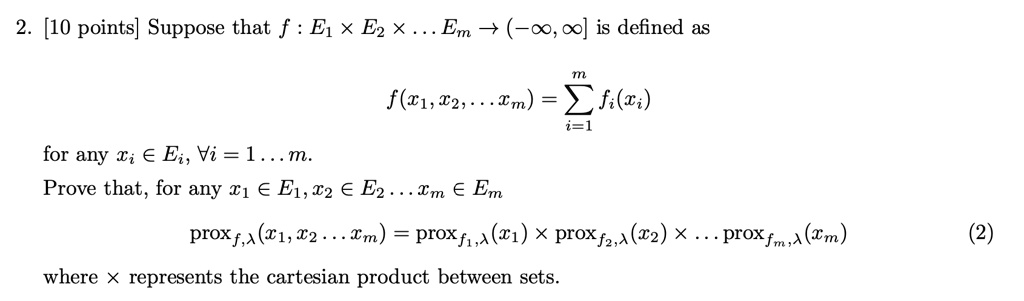
Suppose that $f: E_1 \times E_2 \times \dots \times E_m \to (-\infty, \infty]$ is defined as $$f(x_1, x_2, \dots, x_m) = \sum_{i=1}^m f_i(x_i)$$ for any $x_i \in E_i, \forall i = 1 \dots m$. Prove that, for any $x_1 \in E_1, x_2 \in E_2 \dots x_m \in E_m$ $$prox_{f, \lambda}(x_1, x_2, \dots, x_m) = prox_{f_1, \lambda}(x_1) \times prox_{f_2, \lambda}(x_2) \times \dots prox_{f_m, \lambda}(x_m)$$ where $\times$ represents the cartesian product between sets.
View Answer
divider
BEST MATCH

Which of the following statements about relevant risk and irrelevant risk is correct? Relevant risk includes inflation risk, but excludes political risk. Relevant risk includes exchange rate risk, but excludes inflation risk. Relevant risk includes interest rate risk, but excludes a firm's default risk. Relevant risk includes economic risk, but excludes exchange rate risk. Relevant risk incl

View Answer
divider
BEST MATCH

The Rogers research group has just published a study looking at 2 cases of the rare genetic condition called fibrodysplasia ossificans progressiva (FOP). They examined the role nutrient intake plays in progression of the disease in these 2 cases. How would this study be classified?

View Answer
divider
BEST MATCH

A chemistry student is given \( 650 . \mathrm{mL} \) of a clear aqueous solution at \( 22 .{ }^{\circ} \mathrm{C} \). He is told an unknown amount of a certain compound \( X \) is dissolved in the solution. The student allows the solution to cool to \( 22 .{ }^{\circ} \mathrm{C} \). The solution remains clear. He then evaporates all of the water under vacuum. A precipitate remains. The student washes, dries and weighs the precipitate. It weighs \( 0.019 \mathrm{~kg} \). \begin{tabular}{|c|c|c|c|} \hline \begin{tabular}{l} Using only the information above, can you calculate \\ the solubility of \( X \) in water at \( 22 .^{\circ} \mathrm{C} \) ? \end{tabular} & \begin{tabular}{l} yes \\ no \end{tabular} & \multirow{2}{*}{\multicolumn{2}{|c|}{\begin{tabular}{lll} \( \square \times 10 \) & \( \mu \) & \( \square^{\square} \) \\ \( \square \cdot \square \) & \( \frac{\square}{\square} \) \end{tabular}}} \\ \hline If you said yes, calculate it. & & & \\ \hline \begin{tabular}{l} Be sure your answer has a unit symbol and 2 \\ significant digits. \end{tabular} & L & \( \times \) & 5 \\ \hline \end{tabular}

View Answer
divider
BEST MATCH

what is the difference in policy process and policy making process

View Answer
divider
BEST MATCH

(CH$_3$)$_2$ CH-Br 1. PPh$_3$ 2. BuLi 3. CH$_2$CH$_2$CHO 4. H$_2$O ?

View Answer
divider
BEST MATCH

Question 7 In decision analysis the expected value is computed by taking the total of probability plus pay off value for each alternative True False

View Answer
divider
BEST MATCH

1.0 0.3 1.0 h(ft) FIGURE P5-3 ? ho R ---B--- FIGURE P5-4 (b) 9 ft 5.3. A tank having a cross-sectional area of 2 ft² is operating at steady state with an inlet flow rate of 2.0 cfm. The flow-head characteristics are shown in Fig. P5-3. (a) Find the transfer function H(s)/Q(s). (b) If the flow to the tank increases from 2.0 to 2.2 cfm according to a step change, calculate the level h two minutes after the change occurs. 5.4. Develop a formula for finding the time constant of the liquid-level system shown in Fig. P5-4 when the average operating level is $h_o$. The resistance R is linear. The tank has three vertical walls and one that slopes at an angle $\alpha$ from the vertical as shown. The distance separating the parallel walls is 1.

View Answer
divider
BEST MATCH

The task of framing a building has been estimated to take an average of 25 days with a standard deviation of 4 days. Normal distribution is assumed. What is the probability that the duration will actually exceed 23 days? What is the probability that the duration will actually exceed 25 days?

View Answer
divider
BEST MATCH

4 The Learning Curve The Mountain \"M\" bike workshop can only sell exactly one customized bike every month, because the city only agrees to issue one plate for this type of modified bike per month. So they make exactly one every month. During the first year of business (12 bikes was made), on average they can make a bike in 100 labor hours. During the second year of business (another 12 was made), they improved a lot and were able to on average make the same bike in 75 labor hours. Unfortunately, we do not have records on how many labor hours they spent to make the bike in each month of the 24 months. Please estimate the learning-curve percentage/rate for their bike production. You may make any assumptions as you need, but please justify them so that they sound reasonable to other engineers in the room.

View Answer
divider